Showing posts sorted by relevance for query Enochian. Sort by date Show all posts

Friday, December 5, 2008

Review: Advanced Enochian Magick by Frater W.I.T.

Years ago Gerald Schueler wrote a book for Llewellyn entitled An Advanced Guide to Enochian Magick as a followup to his first book, Enochian Magic. Schueler was one of the early authors to try and put together a set of books that would allow beginners to start practicing the Enochian magical system, but his work suffered from a number of significant flaws. The "Advanced" book consisted mostly of a recounting of Aleister Crowley's The Vision and the Voice along with Schueler's largely Theosophical interpretations of each aethyr vision. The book included some more complex rituals in the back which, I have to say, for the most part did not work. And yes, I started out working with Schueler's books, so I did try them out. Now Frater W.I.T., author of Enochian Initiation, has published a new similarly-titled book that is a real improvement over Schuler's failed effort. Entitled Advanced Enochian Magick, it is now available from Outskirts Press.

I wound up really enjoying the book, but there are a couple of things that put me off at first glance. The book is subtitled "A Manual of Theory, Training, and Practice for the Novice and the Adept." My first question was why an "advanced" book would include "novice" level material. It seems like a bit of a contradiction, though I've seen this sort of thing before, like with Jason Newcomb's introduction to the Goetia subtitled "A Simple Advanced Key." If it's simple, what's advanced about it? Furthermore, as I read through the early chapters of the book it pretty much felt like everything I was reading was material that I'd seen before - basic Golden Dawn rituals, Timothy Leary's eight-circuit model, the Qabalah, and so forth. But basically what is going on here is that W.I.T. is laying out the magical language that is necessary to understand the more complex rituals later in the book. If you already know this material, you can skip ahead.

The most valuable material in the early chapters is the set of recommended practices for both beginning and more advanced magical practitioners. It is not really new material, but I've seen few books that outline the practices so concisely or make it as clear that there really is quite a bit of work involved in being a magician. It's not a discipline where you can read a few books and then go around proclaiming yourself an expert without ever casting a spell or maintaining a daily ritual practice, which I've seen all too many people do. While I recommend a slightly different sequence of rituals based on my operant field model, the practices outlined by W.I.T. will work fine - and actually doing them will put you head and shoulders above about 90% of the people out there who claim to be magicians but in fact do little to no work.

It should be kept in mind that this is not a "novice" level book, despite the subtitle. The "novice"-level material is laid out with basic instructions, but there is little of the hand-holding that you tend to find in real beginner books. For example, you won't find a whole chapter dedicated to answering the question "Is practicing magick evil?" If you know nothing about magick and are picking this up as your first book you are likely to come away a little confused. You should probably read a few introductory books before you pick this one up if you're just starting out, but for people who are already practitioners looking to learn the Enochian system these straightforward explanations are nice. Given this, I think that W.I.T. oversells the potential power of magick in a way that is unnecessary for its target audience, people who are already practicing magick and understand its usefulness, though I do like seeing an author who doesn't shy away from advocating objective paranormal results.

It is the second half of the book that really shines, once it has covered all the background material and gets into the substance of the Enochian ceremonies. Here we find more material along the lines of the material covered in Enochian Initiation, a complex set of rituals accompanied by accounts of magical results. If every magician did this with the ceremonies he or she performs and published the results we would be well on our way to establishing a knowledge base for magick that is similar to what we find in the physical sciences, and in my opinion establishing such a knowledge base should be the goal of every magician. Secrecy about techniques and results helps no one, and does nothing to make the magick itself more powerful or relevant or meaningful.

Frater W.I.T. approaches Enochian magick from the Golden Dawn perspective as far as attributions and techniques go, much as Aleister Crowley did. I am not going to offer a line-by-line analysis of the rituals in the book simply because in my own Enochian practice I've eliminated many of the Golden Dawn elements and am more of a Dee purist, though I also use attributions from Crowley's The Vision and the Voice and incorporate Thelemic rather than Christian symbolism. I use the 1587 reformed Tablet for my model of the Watchtowers which attributes EDLPRNAA and RAAGIOSL to different directions, I don't use the truncated pyramids for the squares, use a different order for the Angelic Keys, and so forth. That being said, as far as I can tell the rituals follow the Golden Dawn model well and I do know a number of magicians who claim to get really good results with that system. Some of his ideas, such as evoking multiple angels at once, are actually more in keeping with the original Dee system, and as that's the way I usually work Enochian magick I can vouch for it as a very effective practical technique.

The self-initiation ceremony in the book's final chapter is a particularly interesting and powerful piece of magical work. A version of it was published in Enochian Initiation, but this new version includes some additional symbolism and I find it hard to believe that anyone could work through it without getting some sort of tangible result - at least if they've done the work leading up to it. Initiation ceremonies are one of the aspects of the Enochian system that appears to be missing when you work through the diaries and other source documents, and this ceremony or something very similar to it seems like a good way to fill that gap. I've heard of the occasional "Enochian Order" offering some manner of initiation, but as far as I know no groups of this sort have managed to last more than a few years or accumulate more than a handful of members. The Enochian system may just not be suited to such a group structure for some reason.

For magicians working with the Golden Dawn/Thelemic Enochian system (that is, probably most Enochian magicians these days) this is a good book to pick up, especially for the later chapters which show how to put together and perform large and complete Enochian rituals. Such rituals are rarely published anywhere and they serve as good examples for serious and involved practice of the Enochian system. Furthermore, working with multiple angels has proved to be very powerful in my own magical work and this is a technique that is not addressed or usually even mentioned in the books that I've seen on the Golden Dawn Enochian system. As with Enochian Initiation, I wish more magicians would publish this sort of material so that all of us could collaborate more effectively, and I congratulate Frater W.I.T. for his efforts along these lines.

Want to buy your own copy of Advanced Enochian Magick by Frater W.I.T.? Order from my Books and Media page and you can help support Augoeides.

Thursday, February 12, 2009

Enochian Meltdown Stories?

My magical working group has recently started a new series of Enochian rituals evoking the Kings from the Heptarchia Mystica. A couple of years ago we did a similar series with mixed results - we got some good information, but also a lot of stuff that didn't turn out to be very useful. So this time around I've tweaked the ritual structure some more and based on the first couple of workings the series seems to be going well.

One of the members of our group blogged about the series online and got a response from a reader repeating the old "Enochian Meltdown" story - you know, that Enochian magick wrecks your health, finances, relationships and so forth. I've been using the Enochian system for years and I know that this isn't true for me, but I am curious if anyone reading this blog has had bad experiences with the Enochian entities. Frater BH and MY GAL recently did a series of Enochian work and aside from an urge to clean house they appear to be doing just fine.

In addition, in Enochian Vision Magick Lon DuQuette claims that he has never come across a documented case of the "Enochian Meltdown" phenomenon. I find that kind of interesting because he's been an OTO initiate since the mid-seventies in California, and Thelema seems to attract a disproportionate number of Enochian magicians due to Aleister Crowley's interest in the system and the significance of The Vision and the Voice in the Thelemic canon. If Lon really has never come across a case, I'm tempted to dismiss the whole thing as spurious. If the system was really all that dangerous, you would think he would know at least a couple of folks who had trouble with it.

My current working hypothesis is this: Enochian is totally safe as long as you use the proper temple equipment. Frater BH and MY GAL did; their setup is nicer than mine and the pictures are worth a look. I have always worked with the ring, lamen, Holy Table, Sigillum Dei Aemeth, and Ensigns of Creation and am convinced that this is the right way to approach the system. Lon DuQuette uses simpler materials like tagboard and so forth, but he still uses the equipment. All of us are just fine, thank you very much, with no meltdowns to report.

However, there are some authors out there who contend that you don't need any of the furniture and implements for various reasons. The Golden Dawn and Crowley didn't emphasize them and The Vision and the Voice was produced using only a circle in the desert and Crowley's scrying stone. Benjamin Rowe used to argue that the furniture is only for use with the Heptarchial entities. And the list goes on. Somebody did once start to tell me the story of a friend of a friend who supposedly had some problems, but not only did it sound like an urban legend, when I asked if this supposed individual used any of the equipment I was told "of course not."

So here are my questions for anyone out there. Do you know of someone who worked with the Enochian system and had problems that seemed to be related to their Enochian work? If so, what sort of problems did they encounter and did they use any temple furniture or implements? If they used some but not all of the implements, which ones did they use?

Your contributions to the science of magick are much appreciated.

UPDATE (2/16/2009): I've left this post at the top of the page for longer than usual in the hopes that more people will see it. So far boleskine93 has posted a story that he heard about one practitioner that I'm pretty sure I hadn't heard before, but there certainly is not the influx of stories that I would expect if the rumors about the dangers of Enochian magick were true. I'll leave this as the top posting for another day or two and I encourage anyone with a story to add it to the comments, but so far the "Enochian Meltdown" phenomenon remains elusive.

Monday, September 1, 2014

Ministering Angels

I gave the following presentation, "Ministering Angels: The Solomonic Roots of Enochian Magick" at the MNCON Midwest Ordo Tempi Orientis Convention on August 23, 2014. I had submitted it to two previous conferences, but I guess the third time was a charm.

Do what thou wilt shall be the whole of the Law.

The Enochian magical system of John Dee and Edward Kelly has inspired many modern esoteric groups, including the various Golden Dawn traditions, Aleister Crowley's A.'.A.'., and the Aurum Solis. However, much of the Enochian lore developed by these diverse groups is not drawn from and in some cases directly contradicts the source material. A more accurate perspective on the original diaries may be found by approaching the system as an advanced form of Solomonic grimoire magic instead of viewing it through the lens of nineteenth-century Hermetic Qabalah. I have found that approaching the Enochian system in this way, as outlined in my two published books, Mastering the Mystical Heptarchy and Mastering the Great Table, yields a highly effective system of practical magick.

Thursday, March 8, 2012

Mastering the Mystical Heptarchy Review Roundup

Up until now I've been posting reviews of my latest book over on my author web site, but for those of you who haven't had a chance to check my other site out, Mastering the Mystical Heptarchy is continuing to be well-reviewed across the blogosphere. If you're interested in the sort of magick that I actually practice, Heptarchy represents the first published portion of a system I have been working with since the mid-1990's. It's powerful and effective, and a lot less complex than the Golden Dawn Enochian system that frustrated me and eventually drove me back to working with the original source materials.

One of my main goals in writing the book the way that I did is so that it would appeal to practitioners of both Enochian and traditional grimoire magick, as I am of the opinion that the original Enochian system of John Dee and Edward Kelley in fact has a lot in common with the latter system. It incorporates similar tools, similar conjuration structures, and so forth to the grimoire methodology of the sixteenth century, and is heavily influenced by the works of Henry Cornelius Agrippa and contemporary grimoires such as the Almadel. If you go through the Dee diaries themselves this structure is fairly obvious, and as long as it's followed you don't need to work with Enochian Chess or truncated pyramids or even scrying to get solid, practical results.

Here's a collection of the reviews that the book has received so far. To all of you who took the time to review my work, you have my thanks. I've been very pleased with the response the book has received.

Tuesday, April 5, 2011

Mastering the Mystical Heptarchy

Let me tell you all a story. In the mid-1990's I started work on a book on Enochian magick that was tentatively titled The Enochian Universe. At that point I had worked with the Enochian system for many years with great success, and considered myself to be something of an expert on it. I had gone so far at the time as to develop my own personal variation on the system that eschewed many of the Golden Dawn associations and worked with the Enochian angels in a manner based on Renaissance grimoire methods.

My plan for the book was very ambitious. I would cover the language, the history, the various controversies over conflicting versions of the system, and so forth. I would fully expostulate the various temple implements and explain their function in the same sort of detail as you would find in an engineering textbook. I would explain the Golden Dawn system, Aleister Crowley's later revisions, and my own experimental discoveries based on testing hypotheses derived from years of studying John Dee's diaries. Finally, I would include my own new set of Enochian rituals for creating operant fields (though I wasn't using that particular terminology at the time) and raising energy in the manner of the Middle Pillar or Elevenfold Seal. I imagined that it would become the definitive work on Enochian magick and remain so for years to come.

But then my software development career really started to take off. I got derailed on the project, and the manuscript sat languishing on my computer. It wasn't just a matter of having less time to write, but rather the problem was also that with the dramatic scope of the book I kept running into problems reconciling the different versions of the system and different renderings of some of the source texts, as the British museum scans weren't online back then. What I realize now is that the project was just too big - I should have simply written a book on my own synthesis of the system rather than trying to cover all the variations that had arisen during the prior century.

Saturday, January 24, 2026

Cognitive Dissonance?

In the past I have been highly critical of "meltdown stories" involving Enochian magick. The story goes that there is something specific about Enochian that makes it highly dangerous to a person's mental health, and many people allegedly develop mental health problems after working with it. I personally have worked with the system for decades using the methods published in my Mastering Enochian Magick series and never have encountered anything like that, and I can't say that any of my students have either. But I recently heard a bit of information that might suggest something about what could be going on with those narratives.


Magick and mental illness have very little in common. Despite some superficial features - for example, schizophrenic auditory hallucinations versus communicating with spirits - it is not the case that magicians are in some sense working effectively with states of consciousness that might otherwise be pathological. If you spend any time at all with schizophrenic people, it becomes pretty clear that the famous Joseph Cambbell quote, "The psychotic drowns in the same waters in which the mystic swims with delight" is not even remotely accurate. About the only thing psychosis and mysticism have in common is that they both involve altered states of consciousness, and all alterations of consciousness are not the same.


It is also difficult to build causal relationships between mental illness and any sort of practice, spiritual or otherwise, because between a quarter and a third of our population has some form of mental illness. While there are of course mentally ill people in the magical community, I have never seen any valid statistical evidence pointing to the incidence being anywhere near as high as a quarter to a third. If the rates are the same between magical practitioners and the general population, you can't conclude that magick of any sort somehow causes mental illness. This is the main reason I remain skeptical of the alleged Enochian meltdown narrative.


What is true is that people who develop delusions generally develop them in the context of their lives and activities. A person who practices magick and develops paranoid scizophrenia is likely to have delusions about magical ideas, like evil magicians or spirits attacking them. A fundamentalist Christian is likely to have the same delusions about demons. A person who grew up around UFOlogists is likely to have those delusions about aliens. And a person without exposure to any of these alternative communities is probably going to develop them about secret government agencies or law enforcement.


Wednesday, September 23, 2015

Lying About Enochian

I recently came across this article on one of the Facebook Enochian discussion groups, and found it to basically be the biggest bunch of nonsense I've read about Enochian magick in quite some time. While it's true that some of the claims in the article could be simple ignorance, some of it is so blatant that I think it does rise to the level of "lying." A simple Internet search, which the author apparently did not bother to do, would have dispelled much of it.

A warning: this turned out a lot longer than I originally intended, because there's a whole lot of crap to get through. But at the risk of venturing into TL;DR territory, let's start at the beginning.

Angels? Demons? There's no such thing as either! Welcome to the 21st Century. That doesn't stop a lot of people from trying to contact angels though.

So, no surprise, the author is a complete skeptic who doesn't believe in summoning spirits of whatever sort. I disagree, of course, but it is true that if you don't think there's any such thing as angels or demons there's not much point in studying or practicing Enochian magick.

JOHN DEE (1527-1608) invented Enochian "Magick" and tried unsuccessfully to get the spirits to bring him money.

This is the first bit of the bullshit I alluded to in my introduction. It is technically true - Dee did try on a couple of occasions to obtain money and find buried treasure. But it was a tiny percentage of the work that he did, and not his primary focus. For most of his life, Dee received a salary from Elizabeth's court and was not impoverished. His main interest in contacting angels was to gain an understanding of the nature of the spiritual universe, which is quite clear from his diaries.

Dee told Princess Elizabeth she would someday become the Queen, which was a prediction that was certainly possible, considering she was royalty, even though she was an unwilling guest of the Tower of London at the time. It’s unknown how many other nobles he might have also told a similar prediction about gaining the throne, figuring one of them would pay off.

Again, this story is accurate up to a point, but the snark at the end has no basis whatsoever in fact. Sure "nobody knows." But so what? The comment is a meaningless jab without any basis in fact one way or the other. "Nobody knows" whether Dee sacrificed live kittens to ancient Canaanite gods - but is such a thing even remotely likely?

Monday, January 16, 2017

Introduction to Enochian Magick

This article is the text of my presentation given on Saturday, January 14 2017, at my local Ordo Templi Orientis body, Leaping Laughter Lodge in Minneapolis, Minnesota.

Do what thou wilt shall be the whole of the Law.

Welcome to Leaping Laughter Lodge. My name is Scott Stenwick, and I am the author of Mastering the Mystical Heptarchy and Mastering the Great Table. Tonight I will be presenting an introduction to the Enochian magical system of John Dee and Edward Kelley.

The Renaissance and Middle Ages produced many grimoires, a term referring to books of magick that include spirit names, sigils, hierarchies, conjurations, and so forth. In recent years, grimoire magick has grown in popularity. But where exactly did the material found in those grimoires come from? Generally speaking, it seems reasonable to suggest that such books were written down by magicians who obtained their methodologies from working directly with the spirits named in, or associated with, the grimoire in question.

This process, though, remains largely mysterious with one key exception. In the late 16th century, John Dee spent seven years working with a scryer named Edward Kelley, and together the two men transcribed one of the most remarkable systems of magick in all of history. Dee was one of the most learned men in England, and owned one of the largest libraries in Europe at his home in Mortlake. He undertook magical work with Kelley because he sought insights into the nature of spiritual reality that he could not find in his books.

Dee meticulously documented his work with Kelley, along with all of the material that the two of them received from the various angels that they conjured and communicated with. The records that we have span the full seven years, and include all of the back and forth that went on between the two men and the angels. So in effect, the Enochian system is the only grimoire, or set of grimoires, on the planet for which we have the underlying “source code,” to use a computer programming metaphor. It is likely that such processes produced other grimoires as well, but we are not privy to any records of those operations because they have been lost over time – if they were ever even written down at all.

Neither Dee nor Kelley ever referred to the resulting system as "Enochian." This term was coined much later, as in the diaries documenting the work, Dee expressed a desire to walk with God as did the mythological Enoch. Also, the spirits revealed to them an opening prayer that was described as the "Prayer of Enoch." Dee and Kelley usually referred to the magical system and the unique language found within it as "Angelical" - that is, "Angelic" in modern parlance - when they referred to either by name at all. I refer to the system as Enochian in my own works only because that is the name that modern people best know and associate with the system.

Monday, February 22, 2016

The Trouble With Tyson

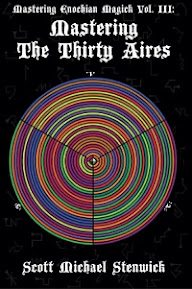
The following post is an excerpt from my upcoming book Mastering the Thirty Aires. I have been critical of Donald Tyson's Enochian works in the first two books of the series, but I was shocked at one point to find myself attacked online by a handful of Enochian magicians who apparently think Tyson's apocalypse musings are awesome or something - just for saying that I thought the whole notion was ridiculous. Tyson's problem is not his scholarship or ability as a researcher, both of which are generally fine. Rather, he seems to be adept at taking bits and pieces of lore and combining them in ways that strike me as completely bizarre.

My new book will mostly consist of the system of the Aires as it appears in Dee's diaries, with some suggested modern practices thrown in where they make sense as optional components. I do, however, include a short chapter on Aleister Crowley's "Scrying the Aethyrs," as it is probably the most popular modern practice that uses the system of the Aires. Also, I'm a Thelemite, so a lot of my cosmology is drawn from Crowley's The Vision and the Voice. I figured that as part of that chapter I would comment on Tyson's own words, blogger-style, so that you can make up your own mind. Maybe he's right and I'm wrong. But I seriously doubt it.


There is one more point with respect to Crowley’s Aethyr workings that I need to address. It is completely ridiculous, but I keep running into people online who apparently believe it.

As I touched on in Mastering the Great Table, Donald Tyson has proposed the concept of an "Enochian Apocalypse" directly tied to Crowley’s Scrying the Aethyrs. Tyson starts by pointing out similarities between the imagery found in the Angelic Keys and certain passages from the Book of Revelation – all of which he describes accurately, as he is generally a competent researcher. But from there, he takes his argument in an utterly bizarre direction, asserting that working the Enochian system will basically lead to the end of the world as we know it.

In my opinion the apocalypse prepared by the Enochian angels must be primarily an internal, spiritual event, and only in a secondary way an external, physical catastrophe. The gates of the Watchtowers that stand guard at the four corners of our dimension of reality are mental constructions. When they are opened, they will admit the demons of Coronzon, not into the physical world, but into our subconscious minds.

Tyson’s argument rests upon the idea that “an apocalypse” fundamentally refers to some sort of catastrophe. But that’s not what the word originally meant. “Apocalypse” is a synonym for “revelation,” which is why the final book of the New Testament is named as it is. If the latter definition were what Tyson was talking about, that working with the Enochian system has the potential to lead the individual magician to a personal revelation – that is, a greater level of mystical realization – I would basically agree with him. I am of the opinion that this is in fact the point of the undeniably apocalyptic language of the Keys. Unfortunately, he keeps going.

Friday, December 16, 2011

Enochian Synchronicities

Back in the late 1990's there was something of a shift in the approach taken to Enochian magick. Up until that time most practitioners had pretty much accepted the Golden Dawn approach as published by Israel Regardie and articulated by Gerald Schueler, who had at that time written several introductory books on the system. One of the big points of contention when working with the Golden Dawn system was the elaborate pronunciation system believed to have been developed by Wynn Wescott. This pronunciation system linked the Angelic language to Hebrew by inserting Hebrew vowel sounds into difficult-to-pronounce clusters of consonants. In the late 1990's, though, a number of authors came to the conclusion that the best pronunciation system was that recorded by John Dee himself during his scrying sessions with Edward Kelley. Today Dee's pronunciation is used by most of the practitioners I know, which is quite different from the situation a decade or so ago. There is still some disagreement regarding how to read Dee's notations for particular words, but the insertion of Hebrew vowels is for the most part a complete non-starter.

Over the past few years it seems like another shift is on its way. The rise in popularity of grimoire magick has renewed interest in studying Enochian magick as a grimoire-based or at least grimoire-influenced style of magick. The Golden Dawn system relied on an elaborate series of Qabalistic associations to link Enochian into the order's version of the Tree of Life, and in fact there are still quite a few magicians who have found that dialect of the system useful. On the other hand, it seems like these days more and more people are working "old school" and many of the recent books on the system reflect this approach. These include Aaron Leitch's The Angelical Language Volume I and Volume II, Stephen Skinner's Practical Angel Magic of John Dee's Enochian Tables, and of course my own Mastering the Mystical Heptarchy, which includes modern ritual forms but still preserves the original structure of the system for those who would rather work with it that way. In addition, one of the first books published based on the original approach, Geoffrey James' The Enochian Evocation of Dr. John Dee is still in print. It was first published in 1983, so it seems to have predated the recent trend by almost thirty years.

Saturday, November 13, 2010

Review: The Angelical Language, Volume I by Aaron Leitch

Enochian magick used to have a relatively small but devoted following. As a student of the system myself, I commonly joked back in the day that if I were to release a book on Enochian it would sell a thousand the first day as every Enochian magician in the world bought their copies the minute they were available and after that I would never sell another one. In the last few years this seems to have changed, as more people are becoming interested in the system.

Enochian even makes an appearance on the popular television program Supernatural as the language spoken by angels to produce various magical effects. Sadly, the show's producers adopted the ridiculous pronunciation method proposed by Wynn Wescott during the Golden Dawn days - drawing out the words by pronouncing each letter as its own syllable. Even though I've worked with the system for years it took me a while to figure out whether the angels were speaking real Angelic or some nonsense language made up by the writers that they were just calling "Enochian." Of course, I also make use of the Angelic language in my novel Arcana as I discuss here.

This last year has also seen a number of new non-fiction books released on Enochian magick. Aaron Leitch, author of Secrets of the Magickal Grimoires, has put out what seems to be the most ambitious of them, a two-volume hardcover set issued by (believe it or not) Llewellyn, which as a publisher seems to be drifting away from its previous stance of targeting every book released at 12-14 year old girls. So far I have only read volume I of the set, titled The Angelical Language, Volume I: The Complete History and Mythos of the Tongue of Angels. Generally speaking the book is quite good, especially as a complement to Geoffrey James' Enochian Evocation, which covers some of the same material. However, there are also a few caveats that I think anyone interested in practicing Enochian magick as Leitch proposes need to be made aware of.

The best thing about the book is that Leitch makes a good case for using the Angelic Calls with the leaves of Liber Loagaeth and is the first author I've seen who outlines a workable system for doing so. I highly commend him for putting all this material together. I know how difficult a task it is firsthand, as I worked on something like it for myself years ago but found it too frustrating and difficult to assemble in a satisfactory manner. There are some quibbles that I have with his formulations, but the overall idea is great.

Among those quibbles is his attributions for the Calls, in which he attempts to classify Calls 4-7 as a grouping when I think most reasonable readings of the first 18 Calls classify the first two as a group followed by 4 groups of 4, making the first grouping 3-6, the second 7-10, the third 11-14, and the fourth 15-18. This isn't necessarily that big a deal - as Leitch outlines the system the leaves and Calls correspond so that even if you decide to attribute the Calls differently you don't need to mess with the system itself.

A much bigger problem is that Leitch assumes that since he believes the Calls to be related to Liber Loagaeth they must therefore NOT be related to the quadrants of the Great Table. In my opinion this constitutes sloppy, either/or thinking. Especially since Leitch includes decent textual support for the idea that the Loagaeth operation is essentially mystical and not practical in nature, it seems much more logical to me to suggest that Loagaeth would represent the mystical side of the system while the Great Table represents the practical magical side - and both use the Calls, which serve as a sort of "bridge" between the two aspects of the system. This is supported by Dee's explicit linkage of the last 30 Calls with the Parts of the Earth via the Aires, which Leitch acknowledges once but then essentially dismisses.

The book also includes his pronunciation key for the Calls, which is the same as the one he published on his web site. I already critiqued that article here. Interestingly, in the introduction to The Angelical Language Leitch thanks a number of people who were working with Dee's pronunciation notes back in the late 1990's - you know, the ones who "passed over Dee's pronunciation notes in silence" according to his web article. So he must be familiar with their work, and I find it rather confusing that he would characterize it as he did. The statement in question is not repeated in the book, so perhaps Leitch has revised his stance since the publication of the web article.

Beyond this the book gives a decent overview of Dee and Kelly's operations with more textual support than I've seen elsewhere, even in Lon DuQuette's Enochian Vision Magick which is probably the best book on Enochian magick that I have ever read. I would be glad to have it in my library for no other reason than its outline of the Loagaeth operation. But you need to take its interpretations with a grain of salt - as with Donald Tyson, a lot of Leitch's conclusions from the material are much shakier than he makes them out to be.

Want to buy your own copy of The Angelical Language, Volume I by Aaron Leitch? Order from my Books and Media page and you can help support Augoeides.

Wednesday, December 26, 2007

Whither "Syncretist Garbage?"

A version of this article was posted on 9/25/2006 on the previous version of this blog. It references two blog comments that were current at that time, one on the old Augoeides and one on another site. Despite these external references that are no longer current, it makes some good points outlining my basic approach to the Enochian magical system.

Enochian magick generates a lot of controversy among modern magicians. For example, in response to one of my original Enochian rituals, one of my OTO brothers wrote:

S.S. makes plain in this post an issue that I have been wrestling with for some time: What to do with the Golden Dawn system? For every minus that the G.D. has against it when paired with the original material, I find a plus. Just to give a couple of examples: I am very into the color scales and I love using the truncated pyramids.

Then, in a thread on the old Augoeides related to Patricia Shaeffer's Enochian Letter Essences, the following comment was made:

There should be enough available in Dee's material to create a system capable of querying itself and generating further revelations. Indeed, that should be the real test of its merit. Any external confabulations will, at best, produce syncretist garbage like the Golden Dawn's, or, at worst, waste time endlessly.

I work from the Scientific Illuminist perspective that contends magick should be a progressive science - that is, it should change and evolve as effective techniques are developed and ineffective ones are discarded. While I would have described myself as a Dee/Kelly purist many years ago, I have also more recently included more syncretic concepts into my Enochian work, including some ideas from the GD system.So when is syncretism a problem, and when is it a good thing that advances the discipline of magick? That's the big question, especially with the Enochian system.

Much of this controversy centers around the contrast between the original system dictated to John Dee and Edward Kelly and the elaborate system developed by Samuel Liddell MacGregor Mathers and Wynn Wescott of the original Hermetic Order of the Golden Dawn. It may very well be that many of the grimoires of the Medieval and Renaissance periods were originally transcribed using similar methods to those used by Dee and Kelly, but it is only the Enochian system for which we actually have the majority of the research notes and are able to refer back to them. The GD system was derived in part from those notes, but it also incorporated a number of elements from Hermetic Qabalah and as a result there are some sigificant differences between the two systems.
  1. The GD system makes use of a pronunciation method for Angelic words that is different from the pronunciation notes made by Dee.
  2. The GD system brings in a whole collection of Qabalistic attributions not mentioned in Dee's notes. This includes the color scales, truncated pyramids, and so forth.
  3. The GD system treats the 91 parts of the Earth as "Governors," when they are places and not spirits in the original notes.
  4. The GD system uses a version of Dee's Great Table based on a set of communications in 1584. A second version, more coherent version of the Great Table from a 1587 communication is used by some modern magicians, including myself.
  5. The GD system attributes the Calls to the quadrants of the Great Table according to a system that is not found anywhere in the Dee and Kelly material.
  6. The GD system does not emphasize the use of the temple furniture and other implements that were described to Dee and Kelly.
Unlike my OTO brother quoted above, I do not make use of the truncated pyramids in my own work, more because I've never really sat down and worked with them rather than because I think there is something wrong with them, but I do use the GD color scales extensively for talismans and lineal figures and those attributions work very well. I think that the GD magicians were correct in the basic premise that there is a Qabalastic structure to the Enochian system. However, in some cases I think problems arise because the Qabalistic model was favored over the original instructions in places where there are contradictions.

I have two basic rules for integrating syncretic elements into the Enochian system. First of all, the new material may add to the original system (1) as long as it does not contradict the original instructions, and (2) as long as it works. The first rule is fairly easy to apply, but the second requires solid research and experimentation. When applied to the list above, the first rule eliminates (1) and (3) outright. Many modern magicians are now moving away from GD pronunciation, so the use of the language itself is moving more in the direction of the original system. Some modern magicians have also commented on the misunderstanding of the relevant section in Dee's True and Faithful Relation that resulted in the GD confusing the Governors (12 zodiacal spirits attributed to the Tribes of Israel) and the 91 parts of the Earth.

(4), The controversy over which version of the Great Table to use, has solid arguments on both sides. Magicians who use the 1584 version note that it was received around the same time as other significant pieces of the system such as the Calls and that it was dictated to Dee by Kelly. The 1587 version was obtained by Kelly scrying on his own, after most of the elements of the Enochian system had been received. The 1587 version is the newest version of the table and is more coherent than the sometimes conflicting communications regarding the 1584 version. Also, from experience I know that sometimes dictation makes it more difficult to put together something as complex as a large grid of letters. At the same time it has been argued that the 1587 version could have been fabricated by Kelly, especially among those who favor the "Kelly was a con artist" narrative that characterize some biographies of Dee. I use the 1587 version because after much experimentation I found that it seemed to work the best of the various versions I tested, and this is a good example demonstrating that in the end, experimentation is the only way to resolve questions where the original material is contradictory.

(5), the order of the Calls, is a case where there is no contradiction between the two systems because no order was ever specified in the original material. My main problem with it is that when actually working around the Holy Table (that is, the altar table, not the grid of letters - Dee used "table" for both) using Dee's conjurations to the quadrants, the Calls mentioning directions become confused. I can go into more detail in another article, but briefly we know that each quadrant of the Great Table (the grid of letters) is attributed to a direction, and in theory a call that refers to the north should be recited when opening part of the Table attributed to the north and so forth. Some of the Calls mention directions, and these do not match when using the GD order. Also, the last four Calls (to me) clearly fall into the same group based on their content, but the GD system groups calls 3-6 together (which I agree with) and then subdivides the remaining 12 into four groups of three (which I disagree with) rather than three additional groups of four.

(6) turns out to resolve itself quickly and easily with experimentation. Enochian magick works without the furniture and implements, but the more you have the better it works. This has held up for me over the course of many years. I still don't have a perfect Enochian temple, but I do keep working on it whenever I can and one of these days it will be complete.

This leaves (2). There is one big problem that I have with GD attributions for the quadrants of the Great Table. The GD system attributes the four quadrants to the elements, which is logical and does seem to work. However, the mistake is that in the GD system the elemental attribution becomes the primary attribution of the quadrant, when in fact the original material names the direction as primary. BATAIVAH is the King of the East. However, when switching from the microcosmic "winds" model to the macrocosmic "zodiacal" model, BATAIVAH is treated as the King of Air and his quadrant is attributed to the west. I am convinced that this is incorrect - rather than BATAIVAH moving from east to west his attribution should shift from Air to Fire. Again, I have testing this out and in my own experience shifting BATAIVAH to fire seems to work better. It is important to note that the truncated pyramid system is still usable when shifting the elements rather than the names - the pyramids themselves just wind up attributed to different letters depending on whether you are working microcosmically or macrocosmically. This could also be an interesting avenue for research, and I may try it out one of these days.

Experimentation is crucial, and I will conclude with the comment that when you are experimenting with new magical techniques what you are looking for is an objectively measurable paranormal effect. Anyone can put together a ritual, perform it, and have it "feel good." The human mind is very malleable, and it's easy to convince yourself of just about anything if you put enough energy into it. An effective spell makes something happen that is relatively unlikely, or produces a real and lasting change in your perception of the world above and beyond what you could manage with self-hypnosis or NLP or any of the other "sleight of mind" systems that do not incorporate the concept of magical energy. The former is the best test because it can be measured directly - (1) did my objective occur, and if so (2) how unlikely was it? A more powerful spell can make a more unlikely thing happen - it's that simple. You will want to record your successes and failures over time with different techniques so that you can go back through your notes and determine which of the techniques you are testing produced the best statistical results. Whichever technique is the best is the one you should use, and remember that there is a lot of individual variation. You need to do your own work, though research done by others may point in a certain direction.

Saturday, December 1, 2018

Books for the Holidays!

Christmas-Gifting-Books-jpg
Cross-posted from my author web site.

With the holiday season upon us, it's good to keep in mind that the gift of books never goes out of style. Of course, I'm talking about my books. My first novel was published in 2009 and since then I've put out additional fiction and non-fiction titles. Naturally, if I do say so myself, they make great gifts.

The Mastering Enochian Magick Series

Mastering the Mystical Heptarchy

Volume I of the Mastering Enochian Magick Series is still the only book I know of dedicated to exploring the Heptarchia Mystica, an early portion of John Dee and Edward Kelley's work that precedes the better-known Great Table and Aires or Aethyrs. The Heptarchial system works with sixteen spirits total, a King and Prince for each day of the week plus a King and Prince who rule over the entire system. This book makes a great introduction to Enochian magick that can get the reader started right away without a lot of the complexity normally associated with the Enochian system, and produce impressive practical results.

Click here to find out more and order your copy today!

Mastering the Great Table

Volume II of the Mastering Enochian Magick Series is my own exposition of the attributions of the Great Table or Watchtowers. It is more controversial than Volume I because the attributions I use are based on my interpretation of the Dee diaries and they don't line up with the attributions used by the Golden Dawn, the Aurum Solis, or Aleister Crowley. Even other "Dee Purists" don't necessarily agree with my reading of the original texts, so this book is not going to be a re-hash of other Watchtower systems that you will find elsewhere. It is, however, rooted in decades of practical work and experience, and the rituals and structures contained therein have been proved highly effective.

Click here to find out more and order your copy today!

Mastering the Thirty Aires - Coming Soon!

Volume III of the Mastering Enochian Magick Series is my exposition of the Aires or Aethyrs based on my work with the Dee diaries rather than the modern attributions derived from the various Golden Dawn-based systems. Mastering the Thirty Aires has been submitted to my publisher but is not available at this time. Watch this space for an announcement once it is ready to order!

Enochian Master Classes

This is not a book but it makes a great gift anyway. I recently participated in a set of Enochian Master Classes along with Jason Augustus Newcomb and Aaron Leitch. These classes are a great opportunity to hear me lecture on my system of Enochian magick and at the same time hear the perspectives of two other longtime practitioners. You can sign up for the course here, and the coupon code STENW-ENOCH7-50 will give you 50% off the registration price.

Click here to sign up today!

Sunday, July 12, 2020

Heptarchia Mystica Presentation Transcript

The following is my prepared transcript for the Heptarchia Mystica talk that I delivered yesterday for OTO Austria. For this one I actually put together a rudimentary PowerPoint presentation, and the slide images are embedded in the text. It was a fun presentation to do and my thanks go out to the folks at OTO Austria for inviting me to speak and making this happen.

Do what thou wilt shall be the whole of the Law.

Welcome to my presentation on Dr. John Dee’s Heptarchia Mystica. I am Scott Stenwick, author of Mastering the Mystical Heptarchy from Pendraig Publishing.


Mastering the Mystical Heptarchy is a practical guide to working with the mystical heptarchy, an often-overlooked portion of John Dee and Edward Kelley’s system of Enochian magick. I have been an OTO initiate since 1995 and have served as a chartered initiator, ordained priest and deacon, local body officer, and currently as Master of Leaping Laughter Lodge in Minneapolis, Minnesota. I have been involved in OTO for almost 25 years, but I had already worked with the Enochian system for years before I joined.

The way that I approach Enochian magick developed over several decades. I started with the Schueler books in the early 1990s and quickly moved on from there to a more “Dee Purist” approach based on Geoffrey James’ Enochian Evocation. At the same time, though, I did not entirely abandon modern ceremonial methods like pentagram and hexagram rituals. What you will find in my books are ritual templates that allow you to work according to the original grimoire structure based solely on prayers and conjurations, but also show where those modern ceremonial forms can optionally be added to the process. This gives the practitioner greater flexibility to approach the work as they see fit.

Tuesday, May 8, 2012

Western Mystery Tradition Conference Canceled


About a month ago I submitted an abstract for a presentation at the Journal Of the Western Mystery Tradition conference, scheduled to be held this July in Milwaukee. Unfortunately, though, the conference has been canceled. This is a real downer, because it sounded like an incredibly cool event. Here's the description, which you can still view online though I suspect it will be taken down soon. The problem appears to have been that the conference was not promoted very well and had trouble attracting presenters and attendees, so if they try it again next year I'll promote it well in advance here on Augoeides. It seems like the sort of event many of us in the magical blogosphere would enjoy attending, so perhaps some of us can help make sure the next one goes forward.

My proposal was to present on my Solomonic-inspired style of Enochian magick. Here's the abstract that I submitted to the conference organizers.

"Ministering Angels: The Solomonic Roots of Enochian Magic"

This paper presents a methodology for working with the Enochian system of magic that is informed by the Solomonic grimoire tradition of the sixteenth century. Scott Michael Stenwick proposes that these Solomonic foundations of John Dee and Edward Kelley's original source material reveal a powerful method of practical magic. This thaumaturgic style of working with angelic spirits is compared and contrasted with modern interpretations and uses of the system, in which the Enochian material is generally approached as part of a theurgic structure based on scrying and complex analysis.

The Enochian magical system has inspired many modern esoteric groups, including the various Golden Dawn traditions, Aleister Crowley's A.'.A.'., and the Aurum Solis. However, much of the Enochian lore developed by these diverse groups is not drawn from and in a some cases directly contradicts the source material. A more accurate perspective may be found by approaching the system as an advanced form of Solomonic grimoire magic instead of viewing it through the lens of nineteenth-century Hermetic Qabalah. In this light the tools and temple furnishings recommended for Enochian operations can be understood in their proper context and the original intended ritual structures can be deduced in a straightforward manner.

Some of the material that I was going to cover is already published in Mastering the Mystical Heptarchy, and the rest will be included in the second book of my Enochian series that I'm still in the process of writing, Mastering the Great Table. I was really looking forward to presenting on my methods at the conference, but it seems I'll have to wait for the next one.

Monday, January 13, 2014

Introduction to the Heptarchia Mystica

This is the text of a presentation I gave on the Heptarchia Mystica over the weekend at Leaping Laughter Lodge here in the Twin Cities. It presents an outline of the Heptarchial system based on material from my book, Mastering the Mystical Heptarchy. The procedure outlined here is Dee's grimoire evocation method, but the book includes an expanded template that shows how to incorporate modern ritual forms into the basic structure.

Dr. John Dee is well known in the occult community as the author of magical diaries from sixteenth century England detailing his operations with scryer Edward Kelley. The diaries span seven years and describe a previously unknown form of angel magick that has come to be known as the Enochian system among modern magical practitioners. Modern Enochian systems such as those derived from the Golden Dawn, Aurum Solis, or Liber Chanokh attributions typically emphasize the Watchtowers, four tablets of letters that are thought to represent the cardinal directions and elements, and the Aires or Aethyrs, regions of space that expand outward from the Earth and are thought to in some manner span the same “psychic space” as the Qabalistic Tree of Life.

Less well known and explored are the angels of the Heptarchia Mystica, Dee’s first attempt at assembling an angelic grimoire. The material found in the Heptarchia was originally received in 1582, Dee’s first year of working with Kelley, and includes descriptions of the implements that commonly represent Enochian magick today such as the Holy Table and Sigil of God. The source diaries can be found in John Dee’s Five Books of Mystery edited by Joseph Peterson, and unlike the rest of the Enochian system Dee also assembled the Heptarchial material into a grimoire form in 1588, which is the Heptarchia Mystica itself. Joseph Peterson has this text available on his website, Twilit Grotto Esoteric Archives, in two versions. The first is titled Compendium Heptarchiae Mysticae and is a sort of rough draft, a compilation of the diaries similar to that found in the Five Books. The second is De Heptarchia Mystica, which is the final text of Dee’s Heptarchial grimoire.

Thursday, June 25, 2026

The Enochian Great Table - Babalon Rising 2026

This year I offered four presentations at the Babalon Rising Festival in Springville, Indiana. I have decided to post those presentation here on the blog for the general public and anyone who attended the festival but was unable to make it to my talks due to scheduling issues. If you are interested in seeing presentations like this in a festival setting, I highly recommend the Babalon Rising Festival. It happens every year during the second weekend in June. This presentation is an updated version of this earlier presentation that I gave at Leaping Laughter Lodge in 2014. It covers material from my book Mastering the Great Table and walks through how I do evocations of the various Great Table spirits.


The Enochian magical system of Dr. John Dee and scryer Edward Kelley has inspired ritual magicians for centuries. Dee’s spirit diaries were first published in 1659 by Meric Causaubon, a clergyman who sought to discredit personal spiritual revelations by making the case that even John Dee, one of the most intelligent men of his age, was nonetheless taken in by evil spirits. Causaubon’s sixty-page preface to this effect was mostly ignored, but his edition of the diaries, A True and Faithful Relation of What Passed for Many Years Between Dr. John Dee and Some Spirits (normally abbreviated TFR by modern magicians) made Dee’s work available to an audience for the first time.


By 1700 the first attempt to integrate the Dee material into the canon of Western magick was published as the Treatise on Angel Magic, attributed to one "Dr. Rudd." In this volume we find some curious attributions that were passed on by early Enochian authors, such as attempts to mix Goetic and Enochian spirits. While there is some overlap between Enochian and Goetic practitioners, the two systems in fact have nothing to do with each other. That did not stop Rudd, though, from creating his own versions of implements such as the seven Ensigns of Creation that added Goetic spirit names to Dee’s designs. His Table of Art is also an odd synthesis of Dee’s Holy Table and other magical containment structures of the period.


The most famous system of Enochian magick was developed by the Hermetic Order of the Golden Dawn in the late nineteenth century. The Golden Dawn system was influential enough that for much of the twentieth century it was what everyone thought of as Enochian magick. Aleister Crowley’s version was derived from the Golden Dawn version and similar enough that it was essentially a dialect of the system. But in the 1970’s and 1980’s Enochian magicians started going back to the original sources, most of which were maintained by the British Museum. Today these documents are available as online scans, making Dee’s original work more widely available than ever before.


Monday, March 9, 2009

Aaron Leitch on Angelic Pronunciation

I consider Aaron Leitch's Secrets of the Magical Grimoires to be an excellent piece of work on Medieval and Renaissance ceremonial magick. It covers most of the major grimoires and gives good instructions for working with them, and while Leitch seems to be coming at the material from the same perspective as Joseph Lisiewski, he is less dogmatic about it and I think that he does a better job of explaining the reasoning behind his perspective. While I disagree with the idea that the old grimoires are "better" in some way than modern magical techniques because they represent a living tradition of esotericism up until those dated around the Renaissance, from a scholarly perspective his material appears to be essentially correct regarding the usage of such magical texts.

What bothers me a bit about some of Leitch's articles is that while his scholarship is generally solid I sometimes find his writing to be a bit smug and self-aggrandizing. I read an article awhile back that he put together on the Abramelin squares that insisted "for the first time" he had discovered the correct organization of the squares, more correct even than the most recent edition of Abramelin that corrected many mistakes from the original Mathers translation. I don't know very much about the formal Abramelin system so I was willing to give him the benefit of the doubt even though his comments set off a couple of warning flags. A lot of smart people have looked at this material over many years, and the way the article was worded seemed to vaguely imply that clearly none of them were as smart as the great Aaron Leitch who finally managed to decode what they could not. I am exaggerating somewhat for effect, but I still found that the implication detracted from the article.

Seeing as I wasn't going to go delving into my own texts and spend a lot of time working out how correct Leitch's Abramelin squares were, I decided to reserve judgment until he published something on a subject that I do know a lot about and have studied for many years. That opportunity recently presented itself, as Leitch has published a new article on the Internet regarding the pronunciation of John Dee's Angelic language that is slated to be published as part of a new Enochian book that he is writing for Llewellyn. Sure enough, the smugness was back. For example:

As a result, many scholars and occultists have ignored or misinterpreted Dee's notations. (I once read a theory that the notes were actually alternate spellings for the primary words!) Each individual or group that has adopted the Angelical Callings into their magickal systems has developed their own specialized methods of pronunciation. Perhaps the most famous example is the Order of the Golden Dawn, which applied Hebrew rules for vowel-sounds whenever the words contained groupings of consonants. Since then, others have attempted to create pronunciation keys closer to what Dee may have intended (see Laycock's Complete Enochian Dictionary and Christeos Pir's An Essay on Enochian Pronunciation), but these scholars have also passed over Dee's phonetic notations in silence.

I don't have my Laycock handy at the moment, but here's an excerpt from Christeos Pir's essay on Enochian pronunciation.

Where Dee has separated a word into its syllables (eg, Im ua mar), I have hyphenated it so as to more easily discern between word divisions and syllable divisions (Im-ua-mar). Where he has shown stress by using an accent, I have used boldface (q-a-an). In a number of places his marginalia give more than one version of a word, usually in order to clarify its pronunciation; other times he has occasionally written an example for the same purpose -- these I have placed in footnotes.

I have no idea how this essay could possibly be construed as passing over Dee's phonetic notations "in silence." Pir refers to them explicitly! Either Leitch didn't read Pir's essay as closely as he thought he did, or he was hoping that his readers wouldn't actually check.

Furthermore, while whoever put forth the "alternative spelling" idea was clearly ignorant of the original material, the implication that nobody has paid much attention to Dee's phonetic notes is profoundly incorrect. The authors who have done so include Geoffrey James in 1983's Enochian Evocation, Lon Milo DuQuette in 1997's Angels, Demons, and Gods of the New Millenium and of course 2008's Enochian Vision Magick, David Griffin in 1999's The Ritual Magic Manual, and the list goes on. In fact, this leads me to wonder if by "others" Leitch really just means Gerald Schueler and possibly Pat Zalewski - I don't recall whether or not Zalewski mentioned Dee's phonetic notes in Golden Dawn Enochian Magic, but to be fair Zalewski was writing specifically about the Golden Dawn Enochian system.

At any rate, Leitch's interpretation of Dee’s pronunciation notes is reasonably good aside from a couple of problems. The most significant of these is that there is very little evidence supporting his contention that Angelic letters are ever pronounced by just saying the name of the English letter as a full syllable. This idea was first proposed by Leo Vinci in his Gmicalzoma Enochian dictionary and it has never made very much sense to me. For example, in the First Key Leitch contends that DS should be pronounced “dee-es” rather than the more natural “des” or “das” and that CA should be pronounced “see-ay” rather than the obvious “kah.” He also contends that NAZPSAD be pronounced “nays-pee-sad” rather than the obvious “nahz-psad” on the grounds that P and S don’t combine, so you should just say “pee” for the middle syllable of the word. Not only is this a bad solution, the "problem" with PS is in fact no big deal. The word can be pronounced as written quite easily once you are familiar with how it is said.

To digress for a moment, one of the problems that English speakers commonly run into with Angelic is that they decide two sounds don't go together on the grounds that they contain a combination of consonants that are not found in English. In many cases the combinations are only difficult to pronounce because the speaker doesn't have the right sort of muscle memory to speak it easily rather than for any physical reason involving the structure of the mouth and tongue. As with any foreign language, this problem can be resolved through practice. Take VORSG as an example. The RSG is hard to say when you first try it - the word tends to come out in two syllables as "VOR-SAG." But imagine putting a K on the end of the word instead of a G, ending the word on a combination of sounds that are more commonly found in English - VORSK. This is actually no harder to say than VORSG, it just is more familiar. Try alternating the two words and you'll see what I mean. The NAZPSAD example is similar - PS in English commonly is turned into just an S as in Psalm, but it can also be pronounced as written with a some practice.

Getting back to Leitch's lexicon, there are several other examples that I find highly questionable. He contends that VORSG be pronounced “vorzh” even though the final G is clearly present in Dee’s pronunciation notes, that POAMAL should be pronounced “poh-mal” rather than “poh-ah-mal” even though both the O and A appear in Dee’s pronunciation notes, and that CICLE should be pronounced “sii-kayl” rather than “kee-kleh” based on the usage of LE in several other unrelated Angelic words. This idea starts to drift into the same territory as Geoffrey James’ attempts to “correct” the Angelic Keys by resolving what he saw as inconsistencies in the language, when we as non-native speakers don’t necessarily know which sounds should be consistent with each other. Imagine if somebody decided to go through the English language and correct the inconsistencies between different pronunciations of “ough” – through, enough, bough, thorough, and so forth. Who’s to say that Angelic is any more regular?

Some of Leitch's other choices are more a matter of taste and there is little scholarly justification either for or against them, though they can result in words sounding rather different. In my own Enochian work I standardize my vowel pronunciations to mostly short sounds, while Leitch seems to prefer long vowel sounds and uses them extensively. I standardize phonetic C to a K sound while Leitch likes it better as an S sound. I usually standardize G to a hard sound, while Leitch likes soft G's and uses them more commonly. And so on. Choices like these can go in more than one direction and change the sound of the language accordingly, but I will say that none of them result in anything as divergent or, honestly, just plain weird as the Golden Dawn pronunciation system. There are plenty of magicians out there who claim to get good results with the Golden Dawn pronunciation, and using anything that is closer to the original material should make those results even better.

For all of my criticisms, Leitch remains a decent scholar and is smart enough not to claim that his method is the "one true pronunciation." He is also to be commended for adding another published work asserting the primacy of John Dee's actual notations regarding the pronunciation of the language that he and Edward Kelley discovered in their actions with spirits, which strikes me as the only common-sense position one can take regarding the Angelic language. I would far rather run into magicians who treat Leitch's system as the gospel truth than Golden Dawners who insist that I need to insert a bunch of useless Hebrew vowels into my conjurations. There is at least some real scholarly justification for the former.

Wednesday, November 27, 2024

The Enochian Master Class is Back!

A number of years ago I put together a set of videos for an Enochian Master Class organized by Jason Augustus Newcomb. In addition to adding his own set of videos, he enlisted Aaron Leitch to provide a set as well. The class was unavailable for quite some time, but you can now enroll here. Note that Jason hosts the class, so if you run into any technical issues with it he's the person to contact.


As you probably know from reading Augoeides, the three of us disagree on a number of issues related to the Enochian system - and that's a good thing! Enochian is a complex topic, and it is very helpful to sample a wide variety of opinions on the subject in order to learn as much as you can about it. I obviously work with the system the way I do because I have found that way to work best for me over the years, and I assume the same about Jason and Aaron.


Jason mostly sticks with the "Neo-Enochian" Golden Dawn/Thelemic system. Aaron addresses Enochian from the "Dee Purist" standpoint, looking only at the Dee spirit diaries. And I wind up somewhere in the middle, working with "Dee Purist" diary attributions but also including modern forms like pentagram and hexagram rituals corresponding to those attributions. Between the three of us, we cover most of the approaches to the system that you are likely to come across.


Purchasing the course will give you access to all three sets of videos so you can compare and contrast them on their relative merits. Each of us have provided videos on the following topics:


  1. THE HISTORY OF PRACTICE
  2. THE NATURE OF SPIRITS
  3. SETTING UP THE TEMPLE
  4. PRAYERS AND CONJURATIONS
  5. SCRYING AND EVOCATION
  6. PRACTICAL MAGICAL OPERATIONS
  7. INDIVIDUAL ADVICE FROM EACH PRACTITIONER

As some of the videos were long enough to be broken up into two parts, this makes for a total of 23 videos with perspectives from three experienced practitioners with very different takes on the system. It's well worth it if you want to become an expert on the Enochian system and are looking to explore it thoroughly. Also note that along with book sales, proceeds I receive from class enrollments help to support all the free material posted at Augoeides. If you value what I do here, consider enrolling (and buying books) to help keep it all going.


Tuesday, July 25, 2006

Heptarchial Ritual Template

I have been very busy lately cleaning up parts of Operant Magick and working on finishing up Arcana, which is my first fictional novel. I plan on sending it off to literary agents soon to see if there is any interest in a fictional story that includes authentic magical techniques. Unfortunately, that also means that I have not had much time to post stories here since Convergence.

As I think I mentioned when I posted the COMSELH AOIVEAE and COMSELH MADRIAX, my ritual group Comselh Ananael is working on a series of Enochian evocations of the planetary Kings from John Dee's Heptarchia Mystica. This is the ritual template that we are using for this series of rituals based on Dee's prayers and conjurations.

0. The Temple

The ritual space is set up with the Holy Table, Sigillum Dei Aemeth, and Ensigns of Creation in the center. If available, the full Enochian Temple Setup should be used, with the twelve banners lining the circle and a red/green double-weave altar cloth placed over the table. A scrying stone or mirror is placed on the altar cloth above the center of the Sigillum. Also, four smaller Sigillums may be placed under each of the altar table's four legs. The working hypothesis here is that the closer the Temple can be to the Enochian ideal, the better the system will work. While some Enochian ritualists such as Benjamin Rowe have written that the temple furniture described in Dee's Five Books of Mystery are only needed for Heptarchial work, I disagree and have found that having the Holy Table, Sigillum Dei Aemeth, PELE ring, and other implements improves all Enochian operations.

There are two officers in this ritual, the Magus and the Scryer. Magus acts as the Officiant and should wear the Enochian ring and lamen. The officers and all others present should wear white robes. The Scryer attempts to contact the conjured spirit or spirits using the mirror or crystal. This is how Dee and Kelly worked when they received the original Enochian material. The bell chime is placed on western edge of the Table. This should be a chime that can be rung easily with one hand, not the bell and dorje. The Scryer will be ringing it when the Angel or Angels appear, so it must not require a shift of attention to operate. Because of this, its exact position should be left to the Scryer's discretion. A low stool for the Scryer is placed to the west of the altar. It should be of such a height that the stone or mirror is at the Scryer's eye level.

I. Opening

All form a circle around the altar and within the banners. Magus initially stands directly west of the altar and Scryer stands directly east. Magus inhales fully, placing the banishing dagger at his or her lips. The air is then expelled as the dagger is swept backwards.

Magus: Bahlasti! Ompehda!

Magus then performs the COMSELH AOIVEAE, moving around the Table and casting in the direction of Scryer who concentrates on receiving the evoked energies. To do this, Scryer stands on the opposite side of the altar from Magus facing him or her as the opening rituals are performed. The idea here is to conjure a line of force that originates with the Magus, passes over or through the stone or mirror, and is received by the Scryer. In addition, all others present rotate appropriately.

II. Taking Refuge

Taking Refuge is part of the Comselh Ananael Ritual Template.

Magus: We take refuge in Nuit, the blue-lidded daughter of sunset, the naked brilliance of the voluptuous night sky, as we issue the call to the awakened nature of all beings, for every man and every woman is a star.

All: AUMGN.

Magus: We take refuge in Hadit, the secret flame that burns in every heart of man and in the core of every star, as we issue the call to our own awakened natures, arousing the coiled serpent about to spring.

All: AUMGN.

Magus: We take refuge in Heru-Ra-Ha, who wields the wand of double power, the wand of the force of Coph Nia, and whose left hand is empty for he has crushed an universe and naught remains, as we unite our awakened natures with those of all beings everywhere and everywhen, dissolving all obstacles and healing all suffering.

All: AUMGN.

IV. Generating Bodhichitta

Like Taking Refuge, Generating Bodhichitta is part of the Comselh Ananael Ritual Template.

Magus: For pure will, unassuaged of purpose, delivered from the lust of result, is in every way perfect.

All: All is pure and present are and has always been so, for existence is pure joy; all the sorrows are but as shadows; they pass and are done; but there is that which remains. To this realization we commit ourselves - pure and total presence. So mote it be.

V. The Magical Field

Magus performs the COMSELH MADRIAX up to the closing. All present rotate appropriately.

Magus: MADRIAX CARMARA, YOLCAM LONSHI!

Magus makes the Sign of Rending the Veil.

VI. The Preliminary Invocation
All make and hold the Sign of Apophis and Typhon. Magus recites the preliminary invocation.

Holy art Thou, who art Universe,
Holy art Thou, who art in Nature formed,
Holy art Thou, the Vast and the Mighty,
Source of Darkness, Source of Light.

All make the Sign of Silence, then clasp hands over hearts and recite the Oration to God.

O Almighty, Eternal, True and Living God: O King of Glory: O Lord of Hosts: O Thou, who art Heaven and Earth and all things visible and invisible: we beseech Thee in this our present petition to have mercy and compassion upon us, who, faithfully and sincerely of long time have made suit unto Thy Divine Majesty, that we may obtain true Gnosis and full understanding of Thy Divine Wisdom, Power and Goodness. And whereas it has pleased Thee of Thy infinite Goodness, by Thy faithful and holy Spiritual Messengers, to deliver unto us long since an orderly form and manner of Exercise Angelic: how, to Thy Honor and Glory, and the comfort of our own souls and of others Thy faithful servants, we may at all times use very many of Thy Holy Angels, their counsels and helps: according to the properties of such their functions and offices, as to them, by Thy Divine Power, Wisdom and Goodness is assigned and limited. Therefore, we heartily and faithfully beseech Thy Divine Majesty to further this our present industry and endeavor to Exercise ourselves, according to the aforesaid orderly form and manner. Grant also unto us this blessing and portion of Thy Heavenly Graces: that thou wilt forthwith enable us, make us apt, and acceptable in body, Soul, and Spirit to enjoy always the Holy and friendly conversation, with the sensible, plain, full and perfect help in word and deed of Thy Mighty, Wise and Good Spiritual Messengers and Ministers generally: and namely of Blessed Michael, Blessed Gabriel, Blessed Raphael and Blessed Uriel: and also, especially of all those which do appertain unto the Heptarchical Mystery and the Mystery of the Great Table. Reveal unto us Thy Majestical Glory, now and forever, through Thy Ministers, the true and faithful Angels of Light.

AMEN. AMEN. AMEN.

Magus rings bell chime.

VII. The Conjuration

Scryer moves to the west of the altar and is seated at the Holy Table, gazing into the stone or mirror. Magus stands behind Scryer and all other participants remain in a circle around the Table.

Magus recites the Fundamental Obeisance:

O YHVH TzABAOTh, we invoke and implore most earnestly your Divine Power, Wisdom and Goodness, and most humbly and faithfully ask you to favor and assist us in all our works, words and cogitations, concerning, promoting orprocuring yourpraise, honor and Glory. And by these your twelve mystical names. ORO, IBAH, AOZPI, MOR, DIAL, HCTGA, OIP, TEAA, PDOCE, MPH, ARSL, GAIOL, most ardently do we entreat and implore your Divine and Omnipotent Majesty: that all your faithful Angelic Spirits whose mystical names are expressed in this book and whose offices are briefly noted, in whatever part of the world they be and, in whatever time of our lives they are summoned by us by means of their peculiar powers or authority of your Holy Names (likewise contained in this book), that most swiftly they come to us visible, affable, and appear to us peacefully and remain with us visibly according to our wishes, and that they disappear at our request from us and from our sight. And through you and that reverence and obedience which they owe you in those twelve mystical names above mentioned, that they give satisfaction amicably to us also, at each and every moment in our lives, and in each and every deed or request to all, some or one of them, and to do this quickly, well, completely and perfectly to discharge, perfect and complete all this according to their virtues and power both general and individual and through the injunctions given them by you (O God) and their charged offices and ministry. AMEN.

All (Excluding Scryer): Through you, YHShVH, AMEN.

Magus then recites the First Call, followed by Scryer reciting the Second Call. There has been a great deal of speculation about the use of the first two Calls, but I have not seen the obvious idea that the Magus recites one and the Scryer recites the other anywhere. The text of the First Call begins with "I reign over you..." and proceeds in the classical European ceremonial manner establishing authority over the spirits through the power of God. The Second Call ends with "and make me a strong Seething, for I am of him that liveth forever." Seething may mean "seer of things" or it may be referring to the Anglo-Saxon "seething" tradition that emphasized trance work and the alteration of consciousness. Either of these interpretations is very appropriate for scrying.

Magus then recites any additional calls associated with the Angels being summoned, moving around the circle if necessary. If this is required, all present rotate appropriately.

Magus recites the appropriate Angelic Invocation, moving around the circle. All rotate appropriately.

All begin to chant the Angelic Names being summoned and visualize the divine light descending into the stone or mirror. When Scryer sees a vision, he or she rings the bell chime and the chant then ends at the conclusion of the current set of vibrations.

VIII. Charge/Communication

The contents of this section depend on the nature of the ritual. Either questions should be asked of the Angels summoned through the Scryer, as Dee and Kelly did when they received the original system, or the Angels should be charged with a task. When this is complete, the Angels are given the license to depart.

IX. The License to Depart

Magus gives the license to depart.

O thou [Insert names of Angels called], because thou hast-diligently answered unto our demands, and hast been very ready and willing to come at our call, we do here license thee to depart unto thy proper place; without causing harm or danger unto man or beast. Depart, then, I say, and be thou very ready to come at our call, being duly exorcised and conjured by these sacred rites of magick. We charge thee to withdraw peaceably and quietly, and the peace of the Almighty, Eternal, True, and Living God be ever continued between us. AMEN.

All: So mote it be!

Magus then concludes the COMSELH MADRIAX.

Magus: MADRIAX CARMARA, ADRPAN LONSHI!

Magus makes the Sign of Closing the Veil. Scryer then rises and joins the circle, standing opposite Magus. All present make either one or two counterclockwise circumambulations to counterbalance those made during the conjurations.

X. Dedicating the Merit

Dedicating the Merit is part of the Comselh Ananael Ritual Template.

All: May the benefit of this act and all acts be dedicated unto the complete liberation and supreme enlightenment of all beings everywhere, pervading space and time. So mote it be. May the benefits of practice, ours and others', come to fruition ultimately and immediately and we remain in a state of presence. AH!

XI. Closing

Magus concludes the COMSELH AOIVEAE.

Magus: I now declare this temple duly closed.

Bell Chime. The rite is at an end.