Showing posts with label fortean. Show all posts

Saturday, February 8, 2020

New Mothman Documentary

The Mothman of Point Pleasant, West Virginia is one of the most famous cryptids in the United States. The creature was originally sighted around the time of the Silver Bridge collapse in 1967. The whole area around western West Virginia and eastern Kentucky has a whole lot of weird activity to this day, as touched on in the Hellier documentary series that I reviewed last month and many other places in the paranormal literature. A new documentary called The Mothman Legacy promises to recount more sightings and shed some light on the events surrounding the mysterious creature.

Per press release, "The final chapter in [Seth] Breedlove's Mothman trilogy, The Mothman Legacy will tell the story of dozens of sightings of a folk legend of dubious origin, who allegedly continues to be seen throughout the area today. With a dozen eyewitness interviews, the film promises to offer some of the most intense and terrifying encounters ever recorded.

"Many believe the Mothman to be a 1960's phenomenon, an omen only appearing before tragedy, and disappearing after a flap of sightings and the subsequent Silver Bridge collapse in 1967. But what if there's more? What if the origins of this omen trace back much further and go much deeper than anyone realized? And what if...the sightings never ended?

"The Mothman Legacy is directed by Seth Breedlove and produced by Adrienne Breedlove. Lyle Blackburn returns to narrate with cinematography by Zac Palmisano and an original score by Brandon Dalo. The Mothman Legacy is being funded through a crowdfunding campaign via Kickstarter which launches Thursday, February 6th. Rewards include copies of the film on DVD and Blu-Ray, posters, t-shirts, and more."

This sounds fascinating, and I probably should watch the other two documentaries in the series to get up to speed before I check this one out. They are Eyes of the Mothman from 2011 and The Mothman of Point Pleasant from 2017. There have been a few non-paranormal explanations floated for the Mothman, such as sightings of large owls. But while those may explain some of the eyewitness reports, it doesn't really address all the other strangeness that surrounds the Mothman legend. Maybe this documentary will.

Wednesday, September 18, 2019

What About Eels?

Longtime readers of Augoeides should be familiar with my contention that the Loch Ness Monster could be an Atlantic sturgeon, as well as the work of Steve Feltham, a longtime Loch Ness researcher who disagrees with me and thinks it's a Wels catfish. But now a recent article from the British tabloid Mirror asks the question that neither of us are asking - what about eels?

Scientists now believe that they may have evidence that the creature could be a ‘giant eel’ after carrying a DNA investigation at the lake. Researchers have been taking samples from Loch Ness and constructing a list of the life that is in the waters by looking at genetic remnants.

Prof Gemmell, who worked on the project, said: ‘We found large amounts of eel DNA in the Loch Ness, every single site we went to had eels. Is it possible there’s a giant eel? Maybe. We don’t know if the DNA is gigantic or just many small eels.’

Let's take a look at this hypothesis. The largest eel by weight in the world is the European Conger, which can grow to almost ten feet long. That's big, but not as big as an Atlantic sturgeon or Wels catfish. I will say that a very large conger could in theory breach the water and explain some of the "hump" sightings of the creature. Looking at pictures like this one I have a much easier time seeing that as an eel than a catfish - even though it really looks more like the back of a sturgeon to me.

Tuesday, March 19, 2019

Watch Out for Unicorns

Anybody who knows anything about magick knows how dangerous unicorns are. Sure, they hide behind their sweetness-and-light exteriors, but underneath they are wild and violent creatures prone to lashing out at any moment. Recently a Baltimore convenience store faced down the wrath of one of these beasts that attempted to rob it armed with only a crowbar and seething unicorn rage.

Baltimore County Police say a person dressed in a unicorn costume and wielding a crowbar tried to rob a convenience store Saturday morning in the Baldwin community.

Officers arrived just after the High’s store opening time of 5 a.m. to respond to the robbery call.

Police say the suspect had fled in a silver car. They located what appeared to be the same car after it had wrecked. No other cars were involved in the wreck.

Miraculously, the cash and cigarettes inside the convenience store remained unmolested as the frustrated creature finally gave up and drove off. But since unicorns are by nature forest dwellers, their driving skills are subpar. The creature wrecked its getaway vehicle and ran off, but is still at large.

Residents of Baltimore, be warned! If you come across this unicorn on the lam, don't try to play music to it or touch its horn or anything like that. Just call the police - your life or at least your cash and cigarettes could depend upon it!

Saturday, September 15, 2018

The Week in Bigfoot

I haven't posted a Bigfoot story here on Augoeides in a while, but a couple of stories have recently popped up on the Internet. First off, from Canada, a lawsuit brought by a Bigfoot hunter named Todd Standing was thrown out by a court in British Columbia.

Todd Standing tried to get the province to acknowledge that the giant, ape-like figure was "an indigenous mammal living within British Columbia". He also claimed the province infringed on his fundamental rights regarding his concern for the creature.

The province argued the civil claim lacked "an air of reality". In a recent decision, British Columbia Supreme Court Justice Kenneth Ball found no reasonable cause for the lawsuit and said the court had no power to compel the province to conduct scientific investigations of its flora and fauna.

The judge also dismissed the claim that Mr Standing's rights were being violated, stating that the province had never placed restrictions on his Bigfoot-related interests. The "non-acknowledgement of the sasquatch does not in any way prohibit or restrict the plaintiff's ability to express his thoughts, beliefs, and opinions regarding the sasquatch," the decisions states.

As much as I find the whole idea amusing, it seems to me that there was never any real standing for the case. Canada doesn't restrict anyone from being interested in the mysterious cryptid, and it's hard to see how Standing could be doing this for any reason besides publicity.

Meanwhile, in Idaho, a regional Bigfoot conference is coming up next weekend. If you're a Bigfoot fan, it sounds like this could be the place to check out.

Wednesday, May 23, 2018

Loch Ness Monster DNA

Totally not a sturgeon or a catfish. Also, totally fake.

I haven't done many cryptozoology posts for awhile, but this story from Reuters caught my eye. Scientists are planning a DNA hunt for the Loch Ness monster, which may finally settle the sturgeon versus catfish debate between longtime monster hunter Steve Feltham and myself. I say sturgeon, he says catfish. Whatever turns up, I'm hoping that it turns out to be more enlightening than the "bigfoot DNA" that turned out to be possum from back in 2013.

Whenever a creature moves through its environment, it leaves behind tiny fragments of DNA from skin, scales, feathers, fur, faeces and urine. “This DNA can be captured, sequenced and then used to identify that creature by comparing the sequence obtained to large databases of known genetic sequences from hundreds of thousands of different organisms,” said team spokesman Professor Neil Gemmell of the University of Otago in New Zealand.

The first written record of a monster relates to the Irish monk St Columba, who is said to have banished a “water beast” to the depths of the River Ness in the 6th century. The most famous picture of Nessie, known as the “surgeon’s photo”, was taken in 1934 and showed a head on a long neck emerging from the water. It was revealed 60 years later to have been a hoax that used a sea monster model attached to a toy submarine.

Countless unsuccessful attempts to track down the monster have been made in the years since, notably in 2003 when the BBC funded an extensive scientific search that used 600 sonar beams and satellite tracking to sweep the full length of the loch.

Supporting Feltham's side, we know for a fact that Loch Ness is home to a population of Wels catfish because the Loch was seeded with the fish back in Victorian times. It is speculated that the Wels catfish can grow to thirteen feet or so, though the verified record is more like nine feet. Still, that's a big catfish.

But many of the pictures I've seen of the monster look more like a sturgeon to me. European sturgeons can grow longer than the Wels catfish, up to twenty feet. They also look a lot weirder and less like a fish that's easily identifiable, and they go back and forth between rivers and the ocean to spawn, like salmon. But we don't know whether or not sturgeons live or spawn in the loch.

Wednesday, November 29, 2017

Meet The Yeti

Granted, he doesn't look that much like a yeti on all fours. But imagine him standing up...

Back in 2013, I covered a paper that claimed to show that "yeti DNA" collected from the Himalayan mountains matched the DNA of an ancient species of polar bear. But as it turned out, that paper had a problem. While it did correctly identify the samples as bear DNA, the section that was highlighted turns out to be a mitochondrial DNA sequence that matches that of almost any bear. Bear evolution expert Charlotte Lindqvist and her team decided to take another look, and compare other regions of the "yeti DNA" with DNA from Himalayan brown bears (Ursus arctos isabellinus). As it turns out, the samples matched. This provides strong evidence that the Himalayan brown bear and the yeti are in fact the same animal.

That previous paper didn’t really prove what it claimed to prove. It looked at a sequence of mitochondrial DNA (yes, the powerhouse of the cell is used in genetic sequencing), but the particular region the scientists focused on is highly conserved in bear populations. That means that polar and brown and black bears all have extremely similar, if not identical, sequences there. It makes no sense to claim that a sample matched an ancient polar bear based on this stretch of DNA, because that sequence would match almost any bear.

To confirm a real match, you have to look at more variable parts of the mitochondrial DNA. So that’s exactly what Lindqvist did. And in the process, she and her international team in Pakistan and Singapore provided the first strong evidence that presumed yetis are actually bears. They published their results in the Proceedings of the Royal Society B on Tuesday. Icon Film secured nine samples that purported to be genuine yeti artifacts, and Lindqvist gathered 15 samples from known bear populations. By sequencing mitochondria from all these sources, she and her fellow researchers were able to determine that all but one of the yeti artifacts actually came from local bears. That last sample was from a dog.

They also figured out that Himalayan brown bears split off from the rest of the regional bear population several thousand years ago, which is why they’re so genetically distinct from most other brown bears. Living in geographic isolation for so long has separated them from other Asian brown bears, and even from their relatives on the nearby Tibetan plateau. They even look different. But prior to Lindqvist’s work, it wasn’t clear just how long Himalayan bears had been on their own. Researchers will need higher-quality samples to figure out the whole picture, but even this small step is major for a species that’s hardly been studied.

We don’t know a lot about Himalayan brown bear behavior, since they’re rare and tend to shy away from people, but bears make sense as a source of mythology. “We know that bears can be aggressive and get up on their hind legs, so they may have been attacking livestock or ravaging local villages,” says Lindqvist. “It’s not that surprising that a large animal like that could feel scary and lead to myths, especially in a culture that lives in very close connection to their environment.”

Tuesday, June 27, 2017

"Man-Sheep" Born in South Africa

Here's one more case showing that the paranormal should never be regarded as the default explanation. A "man-sheep" - a lamb that looks like it could be part human - was recently stillborn in South Africa. As usually happens with weird events like these, many fear that bestiality and witchcraft played a role in the conception of the bizarre-looking creature. But veterinarians who examined the body have a different, more prosaic explanation.

The panic got so great that the Eastern Cape Department of Rural Development sent out experts to carry out tests after pictures of it spread through the community. Chief Director of Veterinary Services Dr Lubabalo Mrwebi admitted that at first glance the lamb which was born dead did resemble a human being but was not part human.

Dr Mrwebi said: “We can confirm this not a hoax photo but that the severely deformed lamb was born by a sheep in Lady Frere this week which at a glance resembles a human form. “It is not however human but a deformed stillborn lamb sired by a sheep and was subsequently infected by a Rift Valley Fever at an early stage of its pregnancy.

“It is worth noting that a sheep has 28 pairs of chromosomes while humans have 23 pairs which is important in dispelling the myth that a union of a sheep ovum and a human sperm can lead to a development of a viable life form. “The deformed lamb exhibits signs that are consistent with an early foetal development that went wrong as a result of a viral infection and nothing more” he said.

So it's not the result of a spell or animal husbandry gone wrong. It's the result of a viral infection. I suppose somebody could cast a spell that made it more likely for a particular sheep or flock of sheep to catch an infection, but that's about all you could do along these lines with magick. Biological explanations are a lot more compelling.

This isn't the first case of a "man-sheep," so apparently sheep fetuses do go through a stage where they look more human than you might expect. Mostly it's the lack of wool, which is unsurprising for a fetus, and the flattened face, which is a mutation that is bred for and viable in some breeds of dog like pugs.

That raises the possibility of breeding a viable flat-faced sheep. Maybe the result would be too disturbing, but maybe that would be the whole reason to do it in the first place.

Wednesday, May 3, 2017

A 2015 Jersey Devil Hoax?

A friend of mine tagged me in a story about a man who claimed to have photographed the elusive Jersey Devil. At first, I decided it wasn't really timely enough to post here because it happened back in 2015. But today, I came across this article from Cryptozoology News with some analysis of the 2015 photo. It's from a couple months ago, so I figured that was at least fairly recent.

At any rate, the photo, which I include above, looks pretty good at first glance. As usual, I considered all sorts of possible explanations involving misidentification of some normal object, and the best I could come up with was a kite. But you also don't see a string or anything like that in the photo, or anybody standing on the right side of the road where they would have to be standing to fly it. So that's probably not it, which puts it in the category of photos that have to be either hoaxes or the real thing.

The image, submitted to Cryptozoology News and seemingly taken from inside the vehicle, shows a blurry and rainy highway with a few blurred cars and a dark flying animal on the top left. The alleged animal appears to be less blurry than the elements in the rest of the elements present in the photograph.

The man said the creature was very large and had “bat-like wings and goat features”. “It was extremely creepy, but we figured we must have just seen it wrong, because of the rain and darkness, but upon looking at the picture it looks like no bird or bat I have seen before,” he said about the alleged November 26th 2015 late evening encounter.

Image analysts tell Cryptozoology News that based on compression characteristics and EXIF metadata, the image initially appears to have been processed or edited with a photo editor software.

Cryptozoologists get a bad rap sometimes for being too credible about sightings and the like, but there you go. The photo is probably a fake that was edited to include the image. It just goes to show that even in some of these fringe communities, there's some real investigation and analysis going on. Interestingly enough, in October of 2015 another Jersey Devil photo was circulated on the Internet, and that story can be found here.

Wednesday, March 29, 2017

Bigfoot Causes Car Crash?

It's been awhile since one of these articles showed up on here on Augoeides. But it's good to know that sasquatch is apparently not entirely gone from the forests of the northwest. According to an Idaho newspaper, a recent car accident has been blamed on the creature, which was seen chasing a deer along a highway.

According to Pullman Radio, the woman, who was not identified, told the Latah County Sheriff’s Office that she saw a Sasquatch chasing a deer on a stretch of US-95 outside of Potlatch. She said the creature was “shaggy” and between 7 and 8 feet tall, the Moscow-Pullman Daily News reported.

The woman checked her mirrors to see the Bigfoot, but as her eyes re-adjusted to the road she hit the deer with her Subaru Forester, the newspaper said. Pullman Radio reported that the woman continued driving, picked up her husband from work then drove to the sheriff’s office to report the incident. Officers did not find any evidence of Bigfoot at the scene of the crash.

One thing that does occur to me is that a hunter in a ghillie suit would look a lot like what this woman is describing, aside from the height - but that can be very difficult to judge, especially if said hunter happened to be kind of tall. A ghillie suit is a modern form of military camouflage, which has a shaggy appearance. A hunter might also be following a deer.

As a matter of fact, back in 2012 a Montana man was hit by cars and killed while trying to perpetrate a bigfoot hoax by walking along a highway wearing one of these suits. It's possible that somebody else had the same idea, though doing it along a highway is particularly dangerous as that Montana man tragically found out. It's also not the best idea for hunting, since it can make you really hard for other hunters to see.

Or maybe this is the real thing. It does seem a little odd, though, since most bigfoot sightings happen in back country and not along busy stretches of road. If bigfoots or bigfeet or whatever hunt for deer along highways, you would think that there would be more sightings. Maybe one of them would even have been hit by a car at this point, which would prove once and for all that the creature really exists.

Friday, August 19, 2016

Billions for Bigfoot?

In 2013, Bigfoot hunter Tom Biscardi founded a company called Bigfoot Project Investments (BGFT), dedicated to searching for the elusive cryptid. In order to raise money to fund various projects, he issued a stock offering this June for his company as a "pink sheets" firm. That is, he sold the stock over-the-counter on one of the country's least regulated markets. Then, about a week ago, the valuation of the company somehow soared to an astronomical ten billion dollars.

A $10 billion valuation puts Bigfoot on a par with Xerox, Discovery Communications and Gap — well-known companies with massive assets and popular products.

Bigfoot, by contrast, lists current assets of $221 in cash along with 73 original casts of Bigfoot footprints, a 109-inch skeleton and a rubber suit from a 2008 Bigfoot hoax. The filings helpfully explain that Bigfoot is known by 15 different names around the world, including Yeti in Tibet, Yowie in Australia and Hibagon in Japan.

In the "risk factors" section of the firm's SEC filings, the company discloses all the potential problems it could face, including problems relating to auditors, its burn rate, and potential future revenue issues. Nowhere does the company say that failing to find Bigfoot is a risk factor. In fact, Biscardi says the firm can make money even if Bigfoot is never actually located.

The firm lists Biscardi's salary at zero dollars: Bigfoot Project Investments is clearly a labor of love. The firm's market capitalization was so off target that even Biscardi — who owns more than 58 percent of the stock — was unaware of the listed market capitalization of the company when CNBC called him this week.

As it turns out, by Wednesday the ridiculously high stock price had disappeared. The SEC is still investigating, but it looks as if the valuation was based on some sort of computer error that affected the listed stock price. Once the error was corrected, it was gone. Biscardi, of course, was never actually able to claim his illusionary billions, but he plans to keep up the search regardless. He's not in it for the money, he's in it to prove the skeptics wrong.

Friday, July 1, 2016

Not the Loch Ness Monster

Longtime readers of this blog know that I've been pushing my hypothesis (note: not "theory") regarding the identity of the Loch Ness Monster for years. I think that the monster is a sturgeon, based on a number of recent pieces of evidence. Monster hunter Steve Feltham, who I covered about a year ago, likewise believes that the monster is a fish, but he has a different candidate in mind - the Wels Catfish, a large fish that was introduced into the loch as a sport fish during the Victorian era.

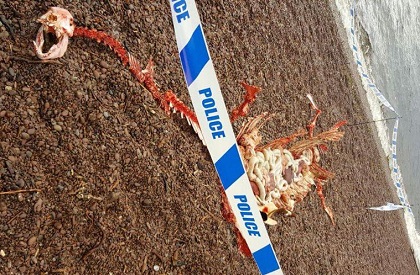
This last week, it seemed as if the discovery of a mysterious set of remains on the shore of the loch might shatter both of those explanations. They appeared to be those of a dinosaur-like creature that clearly was no fish. But the discovery turned out to be not quite what anyone expected.

An animal rescue charity posted the images on its Facebook page saying that a dog walker had found the remains next to Loch Ness.

People across the globe were this morning mourning the apparent loss of the once-mythical beast.

Some, however, have called into question the veracity of the image saying it is strange that the skeletal remains still had the internal organs intact.

Surely they would have been eaten/rotted away with the rest of the flesh?

Help2Rehome Scotland later poured water on all and any theories saying it was actually set out for a TV show.

So the catfish versus sturgeon debate is still alive and well. While the Wels Catfish is a good candidate on the grounds that it is known to live in the loch and sturgeons are not, a number of the photos I have seen suggest a longer fish. The Wels Catfish grows to about nine feet, whereas the European Sea Sturgeon can grow to more than twice that long. At the same time, European Sea Sturgeons are critically endangered, while Wels Catfish are relatively common.

So until somebody comes across a real specimen as opposed to a fake one, the debate will go on over the monster's identity.

Sunday, May 15, 2016

Iceland's Elves Totally Exist

At least, that's the opinion of Icelandic anthropologist Magnus Skarphedinsson, who has spent much of his adult life collecting witness accounts of the creatures. Belief in the existence of elves is widespread in Iceland, where construction projects routinely are modified so as not to disturb them or the places they call home. Many people living in Iceland also claim to have seen and interacted with them, up to and including accounts of elf sex.

Construction sites have been moved so as not to disturb the elves, and fishermen have refused to put out to sea because of their warnings: here in Iceland, these creatures are a part of everyday life. But honestly, do they really exist?

Anthropologist Magnus Skarphedinsson has spent decades collecting witness accounts, and he’s convinced the answer is yes. He now passes on his knowledge to curious crowds as the headmaster of Reykjavik’s Elf School. “There is no doubt that they exist!” exclaims the stout 60-year-old as he addresses his “students”, for the most part tourists fascinated by Icelanders’ belief in elves.

What exactly is an elf? A well-intentioned being, smaller than a person, who lives outdoors and normally does not talk. They are not to be confused with Iceland’s “hidden people”, who resemble humans and almost all of whom speak Icelandic. To convince sceptics that this is not just a myth, Skarphedinsson relays two “witness accounts”, spinning the tales as an accomplished storyteller.

It's hard to say how true the accounts listed in the article are, though if they are accurate they sound like something weird is going on in Iceland. Whether or not elves are the cause is unclear - the various insights about fishing in a couple of the accounts could be a manifestation of psychic vision, and the various problems encountered during the construction project that wound up blamed on elves could have been simple bad luck.

My guess is that the elves are not necessarily physical, but spirits of some sort indigenous to the land that people with psychic awareness can perceive and which have some limited ability to influence the physical world. That still doesn't really explain how one would go about having sex with them, though. If I'm ever in Iceland, this is one thing I want to check out. Because if elves do exist anywhere, it's probably there, and if they are indeed paranormal creatures I would like to meet one.

Tuesday, May 3, 2016

Pope Lick Monster Hunt Turns Deadly

The various weird cryptids that show up in different parts of the country boggle the mind. It seems like just about everywhere, there are stories of bizarre creatures that hide out in remote places. Some of these creatures are said to be shy, and others are said to be malevolent, even deadly.

Kentucky's Pope Lick Monster is one of the few cryptids out there with what appears to be an actual body count. The monster is "part-man, part-goat, and part-sheep" and gets its name from the Pope Lick Trestle, a railroad trestle bridge under which it is supposed to live.

According to folklore, the monster uses some sort of paranormal power to lure its victims onto the trestle bridge, where they are then struck by oncoming trains. The bridge itself is shown in the image above, and as you can see it is very long, very high, and has no handrails or safety features of any kind.

You can probably see where I'm going with this. Last week a young woman was tragically killed when she and her boyfriend ventured out onto the bridge. When a train came, the boyfriend was able to survive by hanging off the side of the bridge, but the woman slipped and fell from the trestle.

"It’s just so sad - a very pretty young girl who had her life in front of her," deputy coroner Jack Arnold said. "It's just so preventable." In her purse, investigators found a work badge that indicated she had worked as a surgical assistant.

There were no signs the couple had been drinking or abusing drugs, but toxicology tests on the victim are pending, he said. Homicide detectives with the Louisville Metro Police Department are investigating, but on Sunday spokeswoman Alicia Smiley said, "There's nothing to indicate foul play."

The train engineer told officials his speed was 32 mph when he saw the couple, sounded the horn and tried to brake, Arnold said. Investigators will review the train's video footage, he said.

The victim and her boyfriend were in town for a paranormal investigation tour, and the boyfriend told police that the couple had gone out onto the bridge in search of the legendary monster. But they encountered a train instead.

The Pope Lick Trestle is so long that there's no way to get off the bridge once you hear a train coming, and there's nowhere on the bridge to stand as it goes by. Basically, all you can do is hang off the side and hope you don't slip - which I imagine is quite difficult, as I'm sure the train shakes the trestle quite hard as it passes.

This, I expect, is the origin of the myth. People are going to explore structures like this; it's only human nature. That makes tragedies like this one practically inevitable. And for those families who lose loved ones, maybe it's easier to have something to blame, even if that something is "part-man, part-goat, and part-sheep."

Friday, April 29, 2016

It's Goatman!

Recently a new photograph of Maryland's Goatman has been circulating on the Internet. So is it real? Goatman is a completely goofy urban legend, a half-man half-goat created by 1970's genetic research gone wrong who now haunts the woods of Prince Georges County on the outskirts of Washington, DC.

The urban legend itself is absolutely absurd. The creature haunts Maryland make out spots, and leaps out at passionate young couples brandishing an ax. The creature was also blamed for locally high-profile pet mutilations in the 1970s.

Many reputable sightings of strange creatures do occur in Bowie, Baltimore, and several other densely populated areas in and around the Washington area, though almost all of the sightings describe large, upright, hairy hominids which sound much more like the equally legendary Bigfoot. Literally hundreds of these sightings have been collected in Mark Opsasnick’s essential book, The Maryland Bigfoot Digest. Hardly any of the people who’ve allegedly seen what they call the Goatman, actually describe a creature like the one in the photo.

I do not agree with WBAL’s assertion that the photograph depicts a bear carrying a dead goat. That’s asinine. The Goat’s head clearly belongs to the body of the hairy creature pictured. I do not, however, believe this to be a legitimate photograph of Goatman. I would never accuse the photographer of being untruthful, but I do believe he, himself to be the victim of a hoax. The whole thing is just too good to be true.

Sadly, I have to agree. The photograph is "real" for what it is, but it's also pretty obviously somebody running around in a costume. It should also be noted that Goatman's iconic fire axe is nowhere to be seen in the picture. An omission on the part of the hoaxer, perhaps?

Goatman is a funny enough legend that maybe for once I agree with an argument made by sasquatch skeptics back in the late 1970's. There very well could be more people out there running around in costumes than anyone realizes.

Saturday, February 27, 2016

Police Apprehend Escaped Unicorn

In the sort of story you don't see every day, police in Madera, California were tasked with apprehending a unicorn named Juliette who escaped from a photo shoot last Wednesday night. It is not clear why she fled the photo shoot, or where she was trying to go while police attempted to chase her down. They initiated their pursuit after receiving calls reporting an unaccompanied unicorn roaming the streets - and everybody knows that unaccompanied unicorns mean nothing but trouble.

The horse had been "posing with kids" during a photo shoot, when she "became frightened" and broke away from her owner. She had been a little unruly earlier in the day (you can't tame unicorns, you know), trying to make a break for it once already before being thwarted. On her second attempt, Juliette was a bit craftier, and got away.

She ran to the streets of Madera Rancheros, at which point onlookers began phoning the California Highway Patrol, reporting that they were seeing a unicorn trotting about the city.

As is typical of unicorns, Juliette was stealthy and elusive in avoiding capture, for at least a few hours. After location efforts proved unsuccessful, the CHP intensified their retrieval procedures.

"The search became so desperate," KTLA 5 reports, "that the local police had to use a helicopter and thermal imaging to locate the pony, which was hiding out in an orchard."

Juliette's owners insist that she is not a unicorn, but rather a pony with a unicorn horn stuck to her head. But that's probably what I would say too if a story made it into the papers reporting on my ownership of such a rare and magical creature. It also explains the enlistment of police, since clearly a real unicorn would be far too valuable to simply allow to run loose in the streets. Who knows what dark magick somebody could accomplish if they managed to get their hands on the horn?

Tuesday, December 1, 2015

Goatman is Trending!

Goatman has to be one of the weirdest and hardest-to-believe urban legends out there. The story goes that a half-man, half-goat was accidentally created by some bizarre experiment at an agricultural research station in Beltsville, Maryland. The creature subsequently escaped, and has gone on the terrorize the woods of Prince Georges County, also in Maryland.

In 2005 a friend and I traveled to Prince Georges County to look for evidence of the Goatman. Sure, there also was a NOTOCON going on in nearby Reston, Virginia, but we went out earlier in the week to spend some time shooting video at some of the locations associated with the legend. We got footage from around Governor's Bridge, an abandoned tuberculosis sanitarium where some sightings had been reported, and so forth.

We never actually saw a Goatman, but we did encounter a few weird things along the way. One of the weirdest was that people at the agricultural research station visitor center refused to say anything about it, or even go on camera stating that they had never heard of the Goatman. It was pretty suspicious, and perhaps implies that government knows more than it's letting on. Or maybe they just thought it was a waste of time.

Anyway, the video linked above has been trending on the Internet lately with the story of Goatman. Most of the details of the legend are correct, although it should be noted that one of the photographs in the video is not a picture of the monster. It's a hunter in a custom-made goat costume, designed to allow him to get closer to a herd of mountain goats.

One other claim in the video is that Goatman might live in a cave near Governor's Bridge, but we found no evidence there of any sort of a cave that might fit the bill. The area around the bridge was still pretty wild when we were out there, with trails through the woods and places where it looked like teenagers - or maybe Goatman! - had built fires and such.

Also, it should be noted that in 2005 Prince Georges County appeared to be undergoing rapid gentrification, with housing developments all over the place. It seemed as if there would soon be no wilds left for Goatman to inhabit. But perhaps the crash of the real estate market in 2008 slowed that process down a bit.

Despite our failure to capture the creature on video, the story of Goatman remains one of the most amusing urban legends that I've encountered over the years. So enjoy!

Thursday, November 5, 2015

Yeti Sightings in Decline

BBC has an article up today about the decline of yeti sightings in Bhutan, once an area in which such sightings were common. It seems that as Bhutan has become a more modern country with electricity and related infrastructure, fewer people spend time in the forest foraging or gathering firewood to heat their homes. Thus, the article theorizes that they have fewer opportunities to encounter the creature.

The last person in Chendebji to have seen possible evidence of the yeti is a younger farmer called Norbu. The first time was 20 years ago, he says, when he was 18. He was in the mountains with his cattle when he saw a large footprint and the body marks of a yeti in the snow. The mere sight of them made his hair stand on end. Then, five years later, Norbu says he discovered something very unusual - a lair made out of intricately woven sticks of bamboo.

"The yeti had broken the bamboo trees, folded them into a semi-circular shape, with the two edges of the bamboo in the ground. He had then slept inside the den. I could see the marks left by the yeti inside the nest," he says.

News of the lair travelled beyond the village and two months later, two men arrived as Norbu was making wood shingles for his house. They asked to see the lair, so he agreed to stop work and show them. Because it was so far away, the three of them had to spend the night in the yeti's nest. The trip passed off peacefully. That was the last time anyone in Chendebji saw traces of the yeti.

Now, says Norbu, people don't need to go up to the mountain to collect wood or graze their animals. They cook on gas rings, and farming patterns have changed. The villagers spend more of their time growing cash crops such as potatoes and oil seeds.

As I've mentioned in the past, I found Reinhold Messner's My Quest for the Yeti to be pretty convincing. He points out that much of the lore about the yeti comes from non-native speakers of local languages misinterpreting descriptions of the creature as some sort of large ape, when in fact the term "yeti" refers to a known animal, the Himalayan bear.

It would be interesting to compare the number of sightings in Bhutan with fluctuations in the local Himalayan bear population. My guess is that they would line up pretty well.

Thursday, July 23, 2015

Sturgeon or Catfish?

A while back I posted a series of articles suggesting that the Loch Ness Monster might be a sturgeon. We pretty much know at this point that it has to be a fish, as any air-breathing mammal or reptile would be surfacing often. Likewise, the fact that a sonar scan of the loch revealed no large creatures means that the only way it could have evaded detection is to have sat on the bottom of the lake or on a ledge. A diver in the 1970's reported seeing something that looked like "an enormous frog," which I contended could have been a sturgeon seen from the front.

While all of that adds up, sturgeons are not known to inhabit the loch. However, as it turns out there's another species of fish that grows quite large, hides on lake bottoms, and could easily look like a giant frog seen from the front. That fish is the Wels Catfish. The picture above shows one of the largest ever caught, measuring 8 feet 8 inches and weighing in at 280 pounds. And we also know that Wels Catfish can be found in the loch, because they were introduced as sport fish during the Victorian era.

Steve Feltham, who has searched for a solution to the Loch Ness mystery for almost 25 years, recently commented that he believes a Wels Catfish is probably the leading explanation at this time. Some newspapers reported this as an admission that he was giving up the hunt, but Feltham fired back that this was not the case and he intends to keep investigating.

Last week, the Times newspaper reported that Steve Feltham, who gave up his job, house and girlfriend 24 years ago to look for the creature full-time, had abandoned his long quest, causing ripples among monster-lovers across the world.

But Feltham says he has no intention of quitting his hunt for the prehistoric beast, which legend has it lurks beneath the deep, dark waters of the lake in northern Scotland, although his current best guess is that "Nessie" is just a large catfish.

"It's still a massive world-class mystery," Feltham, who lives in a van on the shores of the loch, told Reuters. "It's been a life-long passion for me and I'm dedicated to being here and being fully involved in this whole hunt. I couldn't be more content doing anything else."

Feltham said he suspected Nessie was most likely to be a large Wels catfish, a native European fish that can grow up to 13 ft (4 meters) long. Victorians introduced the fish to the loch near Inverness to provide sport. "At the moment, a Wels catfish ticks more of the boxes than any of the other contenders for the explanation," he said.

Wednesday, July 22, 2015

Don't Climb the Monster!

Minne the Lake Creature, a fortean sculpture that moves to a different lake in Minneapolis every summer, is being taken in early from Lake Calhoun this year. The sculpture is made from fiberglass and patterned after the famous surgeon's photo of the Loch Ness monster, which was revealed as a hoax back in 1994.

The photo was faked in 1934 using a tiny model of the creature, but the sculptors decided to build one that was life-sized for display. However, the problem this year is that Calhoun is a lake with a lot of canoe, kayak, and other un-motorized boat traffic, and people just couldn't resist the urge to paddle or swim out to the sculpture and climb all over it.

Minne is the Twin Cities’ only annual floating sculpture. The Parks Foundation first introduced Minneapolis to the Lake Creature in 2009, purchased the sculpture in 2010, and today manages Facebook and Twitter personas (@LakeCreature), which have grown to nearly 5,000 followers combined.

In May, the Parks Foundation invited the public to choose Minne’s 2015 aquatic abode; Lake Calhoun won in a popular vote. At more than five million visits annually, the Chain of Lakes Regional Park is one of the most popular destinations in Minneapolis, with people of all ages and cultures taking part in both land and water activities. Lake Calhoun is the most active in the regional park and boasts biking and walking trails, three beaches, a yacht club, watercraft rental and a restaurant. Minne’s Loch Ness Monster-like appearance created moments of unexpected whimsy for park-goers, and the sculpture quickly became a must-see selfie destination for trail users and paddlers.

“Lake Calhoun embraced Minne the Lake Creature like no other lake – a bit too literally, at times,” says Tom Evers, Executive Director of the Minneapolis Parks Foundation, who notes that as many as three people at a time were witnessed climbing on the Lake Creature this summer. “We want people to engage with Minne from a safe distance because it’s a sculpture, not a climbing structure. It’s better for both Minne and Minneapolitans.”

And this is why we can't have nice things, folks. A handful of idiots can ruin it for everyone else with comparative ease. I suppose I could be smug that nothing like this happened when the statue was put on display in Powderhorn Lake near my home, but the reality is that Powderhorn doesn't have anywhere near the traffic Calhoun does. So statistically speaking, with more people in the water the dumbass subset was bound to emerge.

This makes me sad, both because I won't be able to see the monster for the rest of the summer and because too many of my fellow humans either just don't give a damn or fail to understand that artwork is generally not designed for climbing. See you next year, Minne! Hopefully wherever you wind up folks will treat you better.

Thursday, May 14, 2015

Could Nessie Be An Otter?

A while back I put forth the hypothesis that the Loch Ness Monster could actually be a large sturgeon. Now another expert has come forth claiming that, in fact, people who think they are seeing the monster may actually just be spotting otters. It is true that swimming otters can look like that "humps" that are often attributed to otters, and I was rather surprised at the photograph above, which shows an otter swimming in such a way that it presents the illusion of a head plus two humps. The first hump is formed by the back, and the second by the tail being held in just the right position.

The image was taken by Dr Jonathan Wills, off Lerwick in Shetland, and is of a female otter known locally as Dratsie. Her head, back and tail form three very distinctive humps which, at a distance could be mistaken for a much larger creature.

Dr Wills says the image taken this week proves the beast said to prowl the depths of Loch Ness, hundreds of miles away, is more likely a 4ft otter than a monster. But despite Nessie experts admitting some sightings can be put down to a case of mistaken identity, they continue to insist Loch Ness is home to an unrecorded creature.

Dr Wills, owner of Seabirds-and-Seals boat trips, took the photo while skippering near the north end of Bressay island. He said: ‘We know there are otters in Loch Ness. You can understand why some people believe in the Loch Ness monster when you see three distant humps like this in the water.’

It is well known that people have a hard time judging the sizes of distant objects in the water. Otters may only be four feet long, but that's not exactly small. Furthermore, if two or more swim in a line they could easily be far enough apart that they would look like the humps of some sort of enormous animal. Otters are playful and they do chase each other, both in and out of the water.