Showing posts with label luck. Show all posts

Tuesday, February 18, 2020

The Power of Luck

Why practice magick at all? Some of us, like me, have been fascinated by it from a young age. For most people, though, it remains a niche interest that they just find weird - if they even understand what it is.

The truth is that there's a really compelling reason to practice that has to do with the power and influence of luck in our society and for that matter the rest of the world. Vox has an article up that talks about just how pervasive luck really is, and how much it has to do with how our lives really turn out.

These recent controversies reminded me of the fuss around a book that came out a few years ago: Success and Luck: Good Fortune and the Myth of Meritocracy, by economist Robert Frank. (Vox’s Sean Illing interviewed Frank in 2016.)

It argued that luck plays a large role in every human success and failure, which ought to be a rather banal and uncontroversial point, but the reaction of many commentators was gobsmacked outrage. On Fox Business, Stuart Varney sputtered at Frank: “Do you know how insulting that was, when I read that?”

It’s not difficult to see why many people take offense when reminded of their luck, especially those who have received the most. Allowing for luck can dent our self-conception. It can diminish our sense of control. It opens up all kinds of uncomfortable questions about obligations to other, less fortunate people.

Nonetheless, this is a battle that cannot be bypassed. There can be no ceasefire. Individually, coming to terms with luck is the secular equivalent of religious awakening, the first step in building any coherent universalist moral perspective. Socially, acknowledging the role of luck lays a moral foundation for humane economic, housing, and carceral policy.

Building a more compassionate society means reminding ourselves of luck, and of the gratitude and obligations it entails, against inevitable resistance.

Read the whole article - it's quite good, and makes a point that a lot of people, particularly those who happen to be conventionally successful, don't like to admit.

Friday, October 4, 2013

Rituals and Bad Luck

Skepticism can sometimes get in the way of genuine scientific inquiry. The headline of this recent article is quite misleading, in that it implies that ritual actions can alleviate bad luck. In fact, the study found nothing of the sort because that question was not even asked - instead, it found that ritual actions alleviated peoples' concerns rather than actually affecting their luck.

The study, published in the Journal of Experimental Psychology, explained that people believe that negative outcomes are especially likely after a jinx.If someone says, "No one I know will ever get into a car accident," for example, it often feels that a car accident is likely to occur. But people's elevated concerns after tempting fate can be eliminated if they engage in a ritual to undo that bad luck.

The researchers, from the University of Chicago Booth School of Business, discovered that actions which involve exerting force away from one's body are the most effective at undoing a jinx.Study author Jane Risen said: "Our findings suggest that not all actions to undo a jinx are equally effective."

"Instead, we find that avoidant actions that exert force away from one's representation of self are especially effective for reducing the anticipated negative consequences following a jinx."Engaging in an avoidant action seems to create the sense that the bad luck is being pushed away."

This is all fine and good as a psychological experiment goes, and the idea of incorporating "pushing-away" type gestures into magical rituals may be a nice piece of "sleight-of-mind" for undoing bad luck. However, what's so disappointing about this experiment is that all it needed was one more phase in which the subjects, say, engaged in a game of chance or something similar that would test whether or not the ritual action truly affected their luck.

Since this would have been so easy, why wasn't it done? It seems that it never occurred to the researchers that there was any possibility that luck could be influenced by a ritual. Instead, they confined their study to the subjects' beliefs rather than trying to measure any macrocosmic effect.

Thursday, February 16, 2012

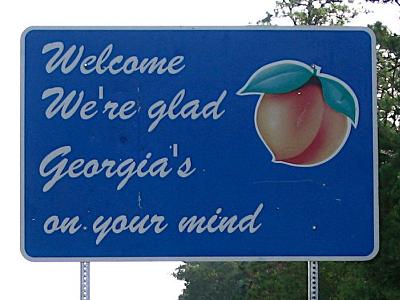
Georgia's Luck Revisited

According to my article awhile back on mapping the luck plane, Georgia is not a particularly lucky state. In fact, when the data points originally compiled by Men's Health magazine are placed on a map, the entire southeast fares rather poorly. In one respect, though, Georgia has the other states in the nation beat - the prevalence of individuals who have won multiple lottery jackpots.

"Georgia is a very lucky state," Georgia Lottery spokeswoman Tandi Reddick tells Yahoo News. "There have been quite a few repeat Georgia Lottery winners who have Lady Luck on their side. It's fantastic for our players and very exciting for us."

Even more amazing, Reddick provided Yahoo News with no less than 15 examples of repeat Georgia lottery winners.

The most recent two-time winner is CNN producer Jennifer Hauser, 29, of Atlanta. Playing the instant scratch off game 50X The Money, Hauser took home a check for $1 million. Incredibly, Hauser's win came less than three months after she took home a $100,000 prize on another state lotto game, Georgia Lottery Black.

From this it would seem that there's some sort of problem in the Men's Health data in terms of mapping out general areas. One obvious issue is that data was only collected for one city in the entire state, Atlanta, and these winners might very well have lived in other areas. There may also be other problems depending on the exact methodology used in the study, which was not disclosed by the magazine. For example, Reno and Las Vegas came out high in part on the strength of high gambling winnings, but I have no idea if any attempt was made to account for the number of winners versus the number of gambling transactions - and if you don't do that, cities where gambling is big business come out ahead of other metropolitan areas even if the number of winners is proportionally the same.

The reality is that such flaws in the data set may render it useless for any sort of meaningful statistical analysis, which is a shame. At first it looked quite promising.

Monday, November 7, 2011

Mapping the Luck Plane

In my previous article on the luckiest city in America I commented that if some sort of pattern could be derived from the "luck ratings" of the 100 cities evaluated by Men's Health magazine, we might be able to get some sort of a handle on how magick interacts with geography in the United States. After running the numbers on the magazine's city ratings, the map shown here (click to enlarge) is the result, with The light blue points representing lucky cities and the purple points representing unlucky cities. Cities marked in green are neutral, and cities not included in the study are shown in gray.

Once I mapped out the points, I went ahead and connected them using a simple heuristic - that one set of lines connect the lucky cities to each other, a second set connects the unlucky cities to each other, and the lines do not cross. There are few outliers - Providence, RI is lucky but just far enough west that you can't draw a line to it from New York City without passing through unlucky Bridgeport, CT. Unlucky Stockton, CA is surrounded by lucky cities on all sides. And while according to the heuristic Denver, CO connects into the West Coast grid, it is a considerable distance from the other cities in the grid and might be an outlier instead. Also, the cities in Alaska and Hawaii are really too far away to be included in either of the continental grids.

Looking at the map, a pattern does become clear. Most of the West Coast is lucky. In the east a lucky swath runs from the area around Baltimore and Philadelphia between the Ohio River and the Great Lakes. Once it reaches Kansas, the swath turns due south until it passes through Texas and Louisiana, reaching Houston and Baton Rouge. My original working hypothesis was that magical forces related to particular elements should follow the physical movement of the element in question. So Earth would move along fault lines, Water would move along rivers, and Air would move along with atmospheric currents. But with the way that the map looks, this analysis seems too simplistic. The lucky eastern swath sort of follows the Ohio and Mississippi rivers, but it runs north of the Ohio and west of the Mississippi, and cities on the river such as Memphis, TN and Little Rock, Ak, are distinctly unlucky.

Friday, October 14, 2011

The Luckiest City in America

One of the most basic premises regarding magick is that it operates in the material world through the manipulation of probabilities. In other words, most successful magical operations essentially involve increasing the caster's luck in some particular situation. Various magical traditions have proposed ideas such as "power spots" and "ley lines," places where this sort of manipulation can more easily be accomplished. English folklore has long maintained that the magical lines of force that run through Great Britain can be traced by drawing lines between various megalithic sites, but here in the United States that's much harder to do. Native Americans may have used a similar system at one time, but with so much of their culture wiped out by European colonization it's hard to determine what that system might have been.

The solution, it seems to me, is that we should make use of our modern understanding of mathematics and statistics to create our own maps outlining places where lucky events happen on a more regular basis. If done properly, this should correspond to areas in which magical operations work better if we assume a normal distribution of high magical aptitude throughout the American population. While I have yet to see a full map of their data, as it turns out Men's Health magazine did just that. The results? San Diego is apparently the luckiest city in America. Baltimore, Phoenix, Wilmington, and Richmond also were high on the list, which might be one reason Rufus Opus has so many more blog followers than I do.

"Luck is basically our modern world's magic," said David Zinczenko, editor in chief of the magazine. "People need to believe in luck because it allows them to give a name to the randomness of life, and when you name something, you have more power over it."

To determine the most charmed towns the magazine analyzed data about cities with the most lottery and sweepstake winners, the most hole-in-ones on the golf course, the fewest lighting strikes, the least deaths from falling objects, and the lowest debt due to playing the lottery and race betting.

Wednesday, March 2, 2011

Beyond Bad Luck

Seeing as I haven't worked as a professional sorcerer, it never has occurred to me to think through what some of the hazards of the job might entail. This story from New York City highlights one of the potential problems with doing luck magick for clients - the people who need it badly enough to come to you are going to be profoundly unlucky. Reading it over I now have a much deeper understanding of why Jason Miller needs to be an expert at protection and reversal magick in order to keep his business going.

Candles ringing a bed in a voodoo ceremony that included sex ignited sheets and clothing strewn nearby and caused a fatal apartment fire last weekend, a city official said Friday.

The blaze started around 6:40 p.m. Sunday, when a woman visited a fourth-floor apartment in Brooklyn and paid a man $300 to perform a mystical ceremony that would bring her good luck, according to fire marshals with the Fire Department of New York.

The man was known in the neighborhood as a priest, and the two were either having sex, or had sex when the fire started from the candles on the floor, though it's not clear if it was part of the ceremony, said the official, who had direct knowledge of the case but spoke to The Associated Press on condition of anonymity because the investigation was ongoing.

Instead of calling 911, the man first tried to put out the fire himself using water from a bathroom sink. As smoke began to gather, one of the other apartment occupants opened a window and propped the hall door open in an attempt to dissipate the plume. But instead, wind gusts shot the flames back inside, creating "a blowtorch effect" that pushed the fire into the hallway, the FDNY said.

The occupants fled as the flames spread. Several 911 calls were made, but it's not clear if the man also phoned. The blaze engulfed the fourth, fifth and sixth floors, causing the floor and part of the roof to collapse. It took nearly 200 firefighters about seven hours to bring the five-alarm blaze under control.

Such worst-case scenarios are why I keep a fire extiguisher in my temple, since it's always possible something as simple as a knocked-over candle can start a serious fire. But at the same time, you would think that anyone with ready access to water would be able to put out something as small as a candle flame starting to burn part of the floor - at least unless a whole lot of negative luck came into play. This toxic luck seems to have even extended to the emergency response, as dispatching errors are rare when the luck plane is behaving normally.

The FDNY is also reviewing a dispatching error that delayed getting water on the fire. One of the engines that had been sent to the fire was already at another emergency. The Uniformed Firefighters Association blamed the delay on recent firefighter staff reductions, though Mayor Michael Bloomberg said it had nothing to do with staffing.

As far as that good luck spell goes I'm guessing it didn't work. That means this particular individual is still out there somewhere and just as unlucky. So if you happen to be in New York City doing spellwork with candles keep the fire extinguisher close at hand.

You know, just in case.