Showing posts with label presentations. Show all posts

Saturday, June 27, 2026

Revisiting the Equations of Magick - Babalon Rising 2026

This is the third of four presentations I offered at the Babalon Rising Festival this year. It is based on a updated version of this post from back in 2008. This material will also be found in my new book Thelemic Sorcery, which I am currently in the process of writing.


Decades ago, I once asked a much more experienced magician who I had a lot of respect for what the limitations of magick were. The answer I got was something to the effect of “Well, does it have any limits?” There may be a sense in which that answer is true, since given nearly infinite time the probability shifts created by magick might allow us to do almost anything. However, it was an answer I found entirely useless. Real things have limits – this is precisely the point of the physical sciences – and understanding those limits is how we understand all phenomena. We cannot assume the omnipotence of the mind without any evidence, and likewise we cannot fall into the common skeptical assumption that if you can do anything paranormal you must be able to do everything that could possibly be described as paranormal.


That conversation proved valuable in motivating me to embark on my own exploration of magick’s exact practical limits One thing we do know is that numerous factors go into figuring out how successful a magical operation will be. One of the early attempts to quantify those factors was a series of equations published in Peter Carroll’s 1992 book Liber Kaos. The chaos magick movement in the 1980’s and early 1990’s represented a significant step forward for practical magick. Peter Carroll and Ray Sherwin first broke magick down to what they considered its essential components. They then approached magical experiments in a scientific way – or at least as scientifically as was practically achievable. Liber Kaos was released around the same time as my fateful conversation, and it proved to be a good starting point for my paranormal research.


Peter J. Carroll passed away on April 22nd of this year at the age of 73. I submitted the proposal for this talk prior to that date and had no idea that he would have passed by the time I would be presenting it at Babalon Rising. While the central thesis of this presentation has to do with places where I disagree with his formulation of magick, it is important to note that he was a true pioneer in this area. Prior to Liber Kaos nobody had ever even floated the idea of probability equations for magical operations. Without his work I would have had nothing to build on, and might never have arrived at any of these revisions.


Too many modern practitioners talk about the “chaos” in chaos magick as something akin to “anarchy.” But while the chaos magick system does reject hierarchy, the original meaning of the term referred to chaos theory, an emerging branch of mathematics. Chaos theory describes systems with arbitrarily large degrees of freedom, independent variables that are nonetheless loosely interlinked. Phenomena that conform to chaos theory principles operate as if any point in this network can act as a critical point, at which a small probabilistic influence can propagate itself into a much larger overall effect.


Friday, June 26, 2026

The Star Sapphire - Babalon Rising 2026

This is the second of four presentations I offered at the Babalon Rising Festival this year. It is based on a updated version of this post from back in 2016. I have done a lot of work with this ritual since then, and am happy to be able to share my insights. This material will also be found in my new book Thelemic Sorcery, which I am currently in the process of writing.


Aleister Crowley's Star Sapphire ritual is one of the most difficult rituals to work out in the entire Thelemic canon. It's not that the ritual instructions are difficult so much as they are so frustratingly vague. If you have seen the Hellier documentary all the way to the end you will see the paranormal investigation crew figure out that a paranormal message they received is telling them to do this ritual. They then completely freak out reading the instructions and decide that it would take them years to learn, let alone attempt.


I was halfway tempted to email them and just offer to do it, since at the time it was a big part of my daily practice. In fact, one of my students did wind up writing them with the same offer but never got a response. Maybe that means they were not quite as freaked out by it as they were suggesting, or maybe it means they had no real intention of following through on it. Whatever the case, Crowley’s vague instructions do no one any favors. He describes the ritual itself in one chapter of The Book of Lies and describes the Holy Hexagram that is traced to the four quarters in another. That’s everything we have to work with.


The Star Sapphire is Crowley's version of the Lesser Ritual of the Hexagram, just as the Star Ruby is his version of the Lesser Ritual of the Pentagram. He described the latter as an "improved" version of the pentagram ritual, so I think it's safe to say that he probably considered the Star Sapphire an improved hexagram ritual as well. It is certainly true that both rituals incorporate more Thelemic symbolism than the Golden Dawn rituals that Crowley sought to improve. There is more than that, though. The structure of the two rituals represents an evolution of the Golden Dawn rituals he originally learned.


Monday, November 24, 2025

Magick Without Fears Hermetic Podcast Interview


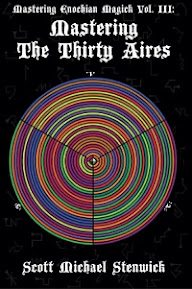
This afternoon I sat down for an interview with Frater RC at the Magick Without Fears Hermetic Podcast. We discussed my latest Enochian book, Mastering the Thirty Aires and a number of other topics related to magick and mysticism. I had a great time as always, and go check out the Magick Without Fears Hermetic Podcast. Frater RC has plenty of great guests discussing fascinating topics surrounding the theory and practice of modern esotericism and magick.


Sunday, August 22, 2021

Enochian Magick Chat

This video is a chat on Enochian magick that I recorded awhile back for the Practicing Magic Faceboook group. The original plan was to stream it live, but we had some technical difficulties and had to record it.


In the chat I discuss some of the basics of Enochian magick, what I like about practicing it, and how I got started - a long time ago at this point! I also talk about my approach to Enochian and how it compares to the approaches of other practitioners.


Enjoy!


Sunday, July 12, 2020

Heptarchia Mystica Presentation Transcript

The following is my prepared transcript for the Heptarchia Mystica talk that I delivered yesterday for OTO Austria. For this one I actually put together a rudimentary PowerPoint presentation, and the slide images are embedded in the text. It was a fun presentation to do and my thanks go out to the folks at OTO Austria for inviting me to speak and making this happen.

Do what thou wilt shall be the whole of the Law.

Welcome to my presentation on Dr. John Dee’s Heptarchia Mystica. I am Scott Stenwick, author of Mastering the Mystical Heptarchy from Pendraig Publishing.


Mastering the Mystical Heptarchy is a practical guide to working with the mystical heptarchy, an often-overlooked portion of John Dee and Edward Kelley’s system of Enochian magick. I have been an OTO initiate since 1995 and have served as a chartered initiator, ordained priest and deacon, local body officer, and currently as Master of Leaping Laughter Lodge in Minneapolis, Minnesota. I have been involved in OTO for almost 25 years, but I had already worked with the Enochian system for years before I joined.

The way that I approach Enochian magick developed over several decades. I started with the Schueler books in the early 1990s and quickly moved on from there to a more “Dee Purist” approach based on Geoffrey James’ Enochian Evocation. At the same time, though, I did not entirely abandon modern ceremonial methods like pentagram and hexagram rituals. What you will find in my books are ritual templates that allow you to work according to the original grimoire structure based solely on prayers and conjurations, but also show where those modern ceremonial forms can optionally be added to the process. This gives the practitioner greater flexibility to approach the work as they see fit.

Monday, August 14, 2017

Heptarchial Evocation Presentation

This week's Magick Monday post is the text of the talk that I gave, and the ritual that I performed, last Friday at the 2017 National Ordo Templi Orientis Convention, NOTOCON XI, in Orlando, Florida. The image shows my traveling Holy Table setup without the cloth and shewstone.

Dr. John Dee is well known in the occult community as the author of magical diaries from sixteenth century England detailing his operations with scryer Edward Kelley. The diaries span seven years and describe a previously unknown form of angel magick that has come to be known as the Enochian system among modern magical practitioners.

Dee’s first attempt at assembling an Angelic grimoire from his diaries was the Heptarchia Mystica. The material was received by Kelley in 1582 and includes descriptions of the implements that commonly represent Enochian magick today such as the Holy Table and Sigillum Dei Aemeth. Dee's Heptarchia Mystica grimoire was assembled years later, in 1588.

The Heptarchia has much in common with other Renaissance grimoires. One of the most common symbol sets found in Renaissance grimoires is that of the seven ancient planets, which also provide the basic schema for the Heptarchial angels. As such, the system is structured with a King and Prince for each day of the week, plus a King and Prince who rule over the system as a whole, for a total of sixteen distinct angels who may be conjured by name for specific purposes.

The temple furniture Dee was instructed to build for his operations is quite elaborate compared to other grimoires of the period. The Holy Table has a three-foot-square top with four three-foot legs, forming the outline of a cube. It was to be constructed of “sweet wood,” which some authors have suggested might allude to cedar. Another source suggests that in the Renaissance, the term referred to wood from any tree that bore fruit. The top of the table should be painted in yellow with a design that incorporates a border of angelic letters enclosing a large hexagram with a 3 x 4 grid of additional angelic letters in the center.

In the middle of the table rests the Sigullum Dei Aemeth, or “true seal of God.” This is a nine-inch diameter disk about an inch thick made from beeswax, into the top of which is engraved a complex image. This incorporates various names of power, lineal figures of the pentagram and heptagram, and a system of letters and numbers around the edge that encodes additional names. The bottom bears a simple cross-based design and the notariquon AGLA.

Monday, January 16, 2017

Introduction to Enochian Magick

This article is the text of my presentation given on Saturday, January 14 2017, at my local Ordo Templi Orientis body, Leaping Laughter Lodge in Minneapolis, Minnesota.

Do what thou wilt shall be the whole of the Law.

Welcome to Leaping Laughter Lodge. My name is Scott Stenwick, and I am the author of Mastering the Mystical Heptarchy and Mastering the Great Table. Tonight I will be presenting an introduction to the Enochian magical system of John Dee and Edward Kelley.

The Renaissance and Middle Ages produced many grimoires, a term referring to books of magick that include spirit names, sigils, hierarchies, conjurations, and so forth. In recent years, grimoire magick has grown in popularity. But where exactly did the material found in those grimoires come from? Generally speaking, it seems reasonable to suggest that such books were written down by magicians who obtained their methodologies from working directly with the spirits named in, or associated with, the grimoire in question.

This process, though, remains largely mysterious with one key exception. In the late 16th century, John Dee spent seven years working with a scryer named Edward Kelley, and together the two men transcribed one of the most remarkable systems of magick in all of history. Dee was one of the most learned men in England, and owned one of the largest libraries in Europe at his home in Mortlake. He undertook magical work with Kelley because he sought insights into the nature of spiritual reality that he could not find in his books.

Dee meticulously documented his work with Kelley, along with all of the material that the two of them received from the various angels that they conjured and communicated with. The records that we have span the full seven years, and include all of the back and forth that went on between the two men and the angels. So in effect, the Enochian system is the only grimoire, or set of grimoires, on the planet for which we have the underlying “source code,” to use a computer programming metaphor. It is likely that such processes produced other grimoires as well, but we are not privy to any records of those operations because they have been lost over time – if they were ever even written down at all.

Neither Dee nor Kelley ever referred to the resulting system as "Enochian." This term was coined much later, as in the diaries documenting the work, Dee expressed a desire to walk with God as did the mythological Enoch. Also, the spirits revealed to them an opening prayer that was described as the "Prayer of Enoch." Dee and Kelley usually referred to the magical system and the unique language found within it as "Angelical" - that is, "Angelic" in modern parlance - when they referred to either by name at all. I refer to the system as Enochian in my own works only because that is the name that modern people best know and associate with the system.

Monday, August 22, 2016

Angels of the Zodiac Presentation

This is a rough transcript of my presentation on the Angels of the Zodiac that I gave at Leaping Laughter Lodge in Minneapolis this last Saturday. A longer and more detailed treatment of this material can be found in the new limited edition anthology Liber Spirituum, currently available from Azoth Press.

Most of the attention of the Western magical tradition seems to be directed at the systems of the elements and planets. To some extent this has to do with how most schools and teachers structure the magical path. First, students learn to work with the elements during their “Outer Order” work, and then work with the planets to perform “Inner Order” operations. The signs of the Zodiac are attributed to the second sephira, Chockmah, and therefore from a sephirothic perspective represent a higher level system than the previous two.

However, in addition to this sephira, Liber 777 attributes the signs of the Zodiac to twelve of the twenty-two paths on the Tree of Life, and these attributions are used for practical Zodiacal magick. These operations are performed in a similar manner to the planetary work, and involve conjuring the appropriate angel by the appropriate divine name. In this form the signs represent forces of the natural world, and it is not necessary to have attained realization of Chockmah in order to work with them.

The terms “Angel” and “Demon” are thrown around a lot by organized Christianity, and they are generally defined in a simplistic manner. Angels are good, and Demons are evil. Obviously, though, this is little more than a value judgment than a technical distinction. In the real world, spirits may be classified as Celestial or Cthonic, according to their particular natures. Celestial spirits are attributed to sky and the stars, while Chthonic spirits are attributed to the earth and the underworld.

According to Christian dogma, Celestial spirits are good spirits called angels and work for God, and Chthonic spirits are evil spirits called Demons and work for Satan. The real spirit world is far less organized; you cannot determine how a spirit will be disposed towards you as a magician based solely on its sphere of influence. While it is true that in general, Cthonic spirits tend to be more hostile and Celestial spirits tend to be friendlier, the various spirits have individual personalities just like humans do. So there are plenty of hostile Celestials and friendly Cthonics.

Monday, April 27, 2015

Introduction to the Thirty Aires

The following is the text of a presentation I gave over the weekend at Leaping Laughter Lodge based on material from my not-yet-published book, Mastering the Thirty Aires. It is a follow-up to my previous Introduction to the Heptarchia Mystica and Introduction to the Great Table presentations. The procedure outlined here is Dee's grimoire evocation method, but the book will include an expanded template showing show how to incorporate modern ritual forms into the structure.

Do what thou wilt shall be the whole of the Law.

The three primary sets of correspondences employed by most Western magicians are the elements, planets, and signs of the zodiac. The Enochian magick of John Dee and Edward Kelley incorporates all three. The material found in the Heptarchia Mystica represents the activity of the seven ancient planets in the form of Kings and Princes of the days of the week. The four quadrants of the Great Table represent the action of the four elements and the “black cross,” which binds them together and is often attributed to the “fifth element,” akasha or spirit. Finally, the twelve signs of the zodiac are attributed to the divisions of the Thirty Aires, the final portion of the Enochian system to be received.

The first two of these components, the Mystical Heptarchy and Great Table, were covered in the first two books of my Mastering Enochian Magick series, Mastering the Mystical Heptarchy and Mastering the Great Table. My planned third book, Mastering the Thirty Aires, has not been released, but this presentation will include some of the material from it. As with my previous introductory talks for the Mystical Heptarchy and Great Table, I hope to provide an overview of working with the Thirty Aires that in true to the original grimoire methods found in the Dee diaries, but which also is open to being informed by modern magical practices.

Monday, September 1, 2014

Ministering Angels

I gave the following presentation, "Ministering Angels: The Solomonic Roots of Enochian Magick" at the MNCON Midwest Ordo Tempi Orientis Convention on August 23, 2014. I had submitted it to two previous conferences, but I guess the third time was a charm.

Do what thou wilt shall be the whole of the Law.

The Enochian magical system of John Dee and Edward Kelly has inspired many modern esoteric groups, including the various Golden Dawn traditions, Aleister Crowley's A.'.A.'., and the Aurum Solis. However, much of the Enochian lore developed by these diverse groups is not drawn from and in some cases directly contradicts the source material. A more accurate perspective on the original diaries may be found by approaching the system as an advanced form of Solomonic grimoire magic instead of viewing it through the lens of nineteenth-century Hermetic Qabalah. I have found that approaching the Enochian system in this way, as outlined in my two published books, Mastering the Mystical Heptarchy and Mastering the Great Table, yields a highly effective system of practical magick.

Monday, March 10, 2014

Introduction to the Great Table


The following is the text of a presentation I gave over the weekend at Leaping Laughter Lodge based on material from my latest book, Mastering the Great Table, as a follow-up to my previous Introduction to the Heptarchia Mystica presentation. The procedure outlined here is Dee's grimoire evocation method, but the book includes an expanded template that shows how to incorporate modern ritual forms into the basic structure.

The Enochian magical system of Dr. John Dee and scryer Edward Kelley has inspired ritual magicians for centuries. Dee’s spirit diaries were first published in 1659 by Meric Causaubon, a clergyman who sought to discredit personal spiritual revelations by making the case that even John Dee, one of the most intelligent men of his age, was nonetheless taken in by evil spirits. Causaubon’s sixty-page preface to this effect was mostly ignored, but his edition of the diaries, A True and Faithful Relation of What Passed for Many Years Between Dr. John Dee and Some Spirits (normally abbreviated TFR by modern magicians) made Dee’s work available to an audience for the first time.

Monday, January 13, 2014

Introduction to the Heptarchia Mystica

This is the text of a presentation I gave on the Heptarchia Mystica over the weekend at Leaping Laughter Lodge here in the Twin Cities. It presents an outline of the Heptarchial system based on material from my book, Mastering the Mystical Heptarchy. The procedure outlined here is Dee's grimoire evocation method, but the book includes an expanded template that shows how to incorporate modern ritual forms into the basic structure.

Dr. John Dee is well known in the occult community as the author of magical diaries from sixteenth century England detailing his operations with scryer Edward Kelley. The diaries span seven years and describe a previously unknown form of angel magick that has come to be known as the Enochian system among modern magical practitioners. Modern Enochian systems such as those derived from the Golden Dawn, Aurum Solis, or Liber Chanokh attributions typically emphasize the Watchtowers, four tablets of letters that are thought to represent the cardinal directions and elements, and the Aires or Aethyrs, regions of space that expand outward from the Earth and are thought to in some manner span the same “psychic space” as the Qabalistic Tree of Life.

Less well known and explored are the angels of the Heptarchia Mystica, Dee’s first attempt at assembling an angelic grimoire. The material found in the Heptarchia was originally received in 1582, Dee’s first year of working with Kelley, and includes descriptions of the implements that commonly represent Enochian magick today such as the Holy Table and Sigil of God. The source diaries can be found in John Dee’s Five Books of Mystery edited by Joseph Peterson, and unlike the rest of the Enochian system Dee also assembled the Heptarchial material into a grimoire form in 1588, which is the Heptarchia Mystica itself. Joseph Peterson has this text available on his website, Twilit Grotto Esoteric Archives, in two versions. The first is titled Compendium Heptarchiae Mysticae and is a sort of rough draft, a compilation of the diaries similar to that found in the Five Books. The second is De Heptarchia Mystica, which is the final text of Dee’s Heptarchial grimoire.

Wednesday, September 21, 2011

The Anatomy of the Mind

I presented a version of this article last week at my Masonic Lodge, Braden #168 in St. Paul, Minnesota. The version published here has been edited to remove specific references to the Masonic degrees, but most of the material remains intact. Readers of this blog should find my basic thesis relatively familiar, as I have written on this topic several times before - notably here and here.

Presentation: Modern neuroscience has reached some interesting conclusions regarding the workings of the mind, especially over the course of the last decade. One of the most important of these is that the psychoanalytic model, in which an “unconscious mind” directs our thoughts and actions, is probably completely wrong. There are brain functions that can be considered “unconscious,” but those functions lack the sort of coherence that would put them even remotely on par with our normal conscious awareness. Similarly, dreaming is not some “gateway to the unconscious” but rather a consolidation process in which memories are sorted and recombined.

The basic anatomy of the mind can be thought of as three distinct systems that work together. The first of these is the declarative mind, or thinking system. This is the portion of the mind that operates according to the general laws of reason and which processes information in the form of thoughts. When somebody asks you what you are thinking about, your answer is what your thinking system is currently processing. The second of these systems is the emotive or feeling system. This is the portion of the mind that produces emotional states. When someone asks you how you are feeling, what you are describing is the current state of your feeling system, whether you’re happy, sad, bored, frustrated, and so forth. These first two systems can be thought of as the “conscious” mind, in that you are always aware of what you are thinking and how you are feeling.

The third system is the conditioning system, which operates according to the principles of behaviorism. The conditioning system is essentially like a machine – its function is to repeat behaviors that have been positively reinforced. Because the conditioning system has no goals and does not think, the behaviors that it prompts can prove problematic. Often, when you do something and are left thinking “why on earth did I do that?” the usual answer to that question is that the behavior was reinforced at some point in the past. This system operates unconsciously, but to call it an “unconscious mind” is a mistake. It does not think in any declarative sense, and lacks the overall internal coherence that we generally associate with the concept of “mind.”

Taken together these three systems constitute what I sometimes think of as the “golden triangle” of consciousness. What we experience as a coherent mind arises from the interaction between them, and they can work together or they can get in each others’ way. If you ever have been in a situation where you have needed to do something difficult or uncomfortable but which nonetheless needs to be done you know how the feeling system can conflict with the thinking system. On the other hand, when you’re in a situation where what you need to do is also rewarding and fun you know how it feels when they work together.

Monday, March 28, 2011

Planetary Magick

This article is a rough transcript of the presentation I gave this last weekend at Paganicon 2011. My presentation was somewhat lightly attended, but unfortunately I wound up scheduled against the guest of honor, John Michael Greer, who is a lot more famous than I am. For those who missed the presentation but are nonetheless interested in the topic, here you go.

Planetary magick has long been a substantial component of the Western Mystery Tradition. While in modern Paganism elemental magick seems to predominate, a look through the grimoires of the Renaissance demonstrates that the seven ancient planets and seven days of the week were at that time a more common symbol set for evoking spirits and casting spells, while the elements were more often seen as part of the alchemical tradition. The planetary symbol set is thus highly suitable for advanced magical and mystical operations.

The next two sections of the presentation, Microcosm and Macrocosm and The Operant Field, summarize the information that I already have posted here and here. The presentation continues with a more detailed description of the changes that are made in the ritual forms when shifting from a microcosmic to a macrocosmic perspective.

Monday, September 27, 2010

The Lesser Ritual of the Pentagram

This article is a rough transcript of the presentation Michele Monstserrat and I wrote and presented at Twin Cities Pagan Pride 2010 this last Saturday. The presentation was well-received and I hope that those who attended now have a deeper understanding of this basic ceremonial ritual.

Various forms of the Lesser Ritual of the Pentagram have been used for more than a century by Western magicians. The LRP in its current form was most likely written by Samuel Liddell MacGregor Mathers, the original Chief Adept of the Hermetic Order of the Golden Dawn. This magical order and its teachings have had a profound effect on the entire Western Mystery Tradition thanks to the publication of certain of its rituals, first by Aleister Crowley in The Equinox and later by Israel Regardie in The Golden Dawn.

It most likely found its way into Wicca and Neopaganism by way of Gerald Gardner, who in addition to founding Gardnerian Wicca was also an initiate of Aleister Crowley's Ordo Templi Orientis and who carried on an extensive correspondence with Crowley in the 1940's when he was putting together the original Gardnerian Book of Shadows.

Today this ritual is found in most introductory books on Western ceremonial magick and is taught in the various Golden Dawn and Thelemic magical orders. The banishing form of this ritual is generally used to initiate ceremonial rituals and as part of circle casting for Wiccan and Neopagan rites.

Tuesday, March 13, 2007

Chaos and Personality: A Hypothetical Model of the Mind (1991)

[Author's Note: I wrote this paper in 1991 for the Paracollege program at St. Olaf College, where I received my undergraduate degree. I've been wanting to make it available online for some time, not necessarily because I agree with its conclusions almost 16 years later, but because it was my first attempt to assemble a model of how the mind works and because some of the ideas presented are proto-versions of ideas that are important to my operant model of magick. These days, my thoughts on the working of the mind run more along the lines outlined in The End of the Unconscious Mind, and unfortunately the Jungian model that I use in this paper does not stand up well to the elimination of the Freudian unconscious. Still, the model does provide some insight into my thought processes that have been developing over the course of the last twenty years. And yes, it's long. You have been warned.]

Abstract

The mind has been the object of a great deal of speculation for a very long time. Only recently, chaos theory, a new movement in mathematics, has provided solutions to many diverse problems related to modeling the natural world. It may also hold the answer to unraveling the mysteries of the mind. This paper describes one possible way in which chaos theory can be applied to modeling the mind. The basis of this model begins with the theories of the psychoanalyst Carl Gustav Jung and goes on to incorporate findings from associationism and behaviorism, in addition to some of the mathematical findings of chaos theory. The result is a comprehensive hypothetical model of how the mind operates.